


It’s almost time for the page to turn again. Whether we like it or not, time marches on, the year comes to a close and we reflect on everything that’s happened. It’s a time for old friends, new loves, and speaking to our feelings so that we don’t dare carry a single burden into another year.
Needless to say, shaking off 2025 will require quite a bit of verbal blotting. The year has felt like a century, at best, and just when things were supposed to wind down and get quiet, a weekend of tumult and tragedy reminded the world just how much we’re suffering. An antisemitic massacre during a Hanukkah celebration at Australia’s Bondi Beach. A shooting at Brown University killed two students and injured nine others. And, late Sunday night, the horrific, violent deaths of Hollywood legend Rob Reiner and his wife, Michele Singer Reiner, purportedly at the hands of their son, Nick. The extent of the horror is indescribable, and it’s occurring on a global scale. And, yes, it often feels as though the weight of it is too much to bear. All we’re left with is confusion and the frustrating feeling of helplessness. We are at our wits’ end. There is no more avoiding, no more pretending. Something has got to change as soon as possible.
There’s something to that. I don’t mean to sound trite or wilfully glib, but it’s merely the truth that every ending is followed by a beginning. Reiner’s seminal film “When Harry Met Sally” is full of them — beginnings and endings, false starts and full stops. It’s a movie for dreamers, realists and romantics alike, the kind of film that’s so fantastic and so painfully human that its brilliant existence is reason enough to believe in good things. Reiner’s filmography was full of these gems, with stunners like “Stand By Me” and “The Princess Bride” that defined not just their era but people’s entire lives.
(Emma McIntyre/Getty Images for TCM) Rob Reiner, Meg Ryan and Billy Crystal attend The 30th Anniversary Screening of “When Harry Met Sally…” on April 11, 2019 in Hollywood, California.
Loving openly and candidly shouldn’t feel like a radical act, but in a world proliferated with violence and hatred, it’s become one.
“When Harry Met Sally,” however, is a special kind of classic. It’s no mere comfort watch, and certainly no chick flick. It’s a film for autumn, winter, spring and summer, just as much of a Christmas and New Year’s movie as it is a Valentine’s Day or anniversary movie. In its bones, there is a deep, true love that is the result of a close working relationship with screenwriter Nora Ephron, stars Billy Crystal and Meg Ryan, and Reiner’s wife, Michele, whom he met and fell in love with during production. Their passion incited a change of the film’s ending, and in turn, one of the all-time great professions of love ever captured on film — a change of fate, right at the stroke of midnight. Call it lightning in a bottle. Call it evidence of magic. Call it a kernel of hope to hold onto as we turn the page.
In Kristin Marguerite Doidge’s 2022 biography of Ephron, the author peers into the fascinating details behind Ephron and Reiner’s long-gestating film, which began as an idea tossed toward Ephron from Reiner after a few lunch meetings. It was over those meals where Ephron became intrigued with the way Reiner talked about his bachelorhood. His anecdotes would become the basis for Crystal’s character, Harry, while Ryan’s witty foil, Sally, was the embodiment of Ephron’s sharp and observant eye. “This is a talk piece,” Reiner said about the film in 1985. “There are no chase scenes, no food fights. This is walks, phones, restaurants, movies.”
A talk piece, indeed. While it’s Ephron’s characteristically strong dialogue and flair for realism that so many viewers fall head over heels for, Reiner’s blissfully simplistic direction is what captures the spark of two people slowly falling in love. Across years, Reiner follows Harry and Sally from their first meeting during a long-haul drive after college through their reconnection and eventual friendship and flirtation. There are long walks and even longer talks, conversations in book stores, on the leaf-strewn concrete sidewalks of a bygone era of New York City and, of course, on the phone. Ephron based the late-night phone conversations between Sally and Harry on Reiner’s frequent talks with Crystal, when the two would watch something on television together and provide commentary throughout. From Sally’s overly particular restaurant orders to Harry’s shock that women fake orgasms, all of it came out in the development process between Ephron and Reiner, and made it into the script. “When Harry Met Sally” rings so true because there isn’t a single false note in its lovely sonata.
Want more from culture than just the latest trend? The Swell highlights art made to last.Sign up here
All of this only makes Reiner’s death all the more tragic. His work wasn’t just his work; his films were pieces of him, generously given to a world that needed their warmth and humor. They’ve stood the test of time because, like all great art, there is truth to them. And there’s no truth quite as simple as “When Harry Met Sally.” All of us are looking for love, and none of us know exactly where to find it. In the decades since its release, dating has only become more complicated, and feeling like you truly know someone can often feel impossible. We’ve hoisted digital and emotional walls up for our protection. Things are bleak enough as they are, after all. Could anyone really be blamed for wanting to avoid even more pain and heartbreak by abstaining from dating altogether?
That’s one option, sure. But consider the other: full, open-hearted professions of love and tenderness. Loving openly and candidly shouldn’t feel like a radical act, but in a world proliferated with violence and hatred, it’s become one. And if there were any time to swallow rejection and embrace compassion, it’s the holidays. Amid the dreadful weekend, news that over 1,400 couples in Washington, D.C. broke the Guinness World Record for kissing under the mistletoe was almost swept under the rug. While it might be a little silly, there’s a real potency to seeing all of those pairs smooching for a few seconds under a giant sprig of mistletoe. The display of adoration and devotion is infectious. It exists in opposition to the darkness creeping over the globe. One imagines couples of many years or even just a few weeks excitedly gathering together, ready to make a memory, and it’s all because one of them asked.

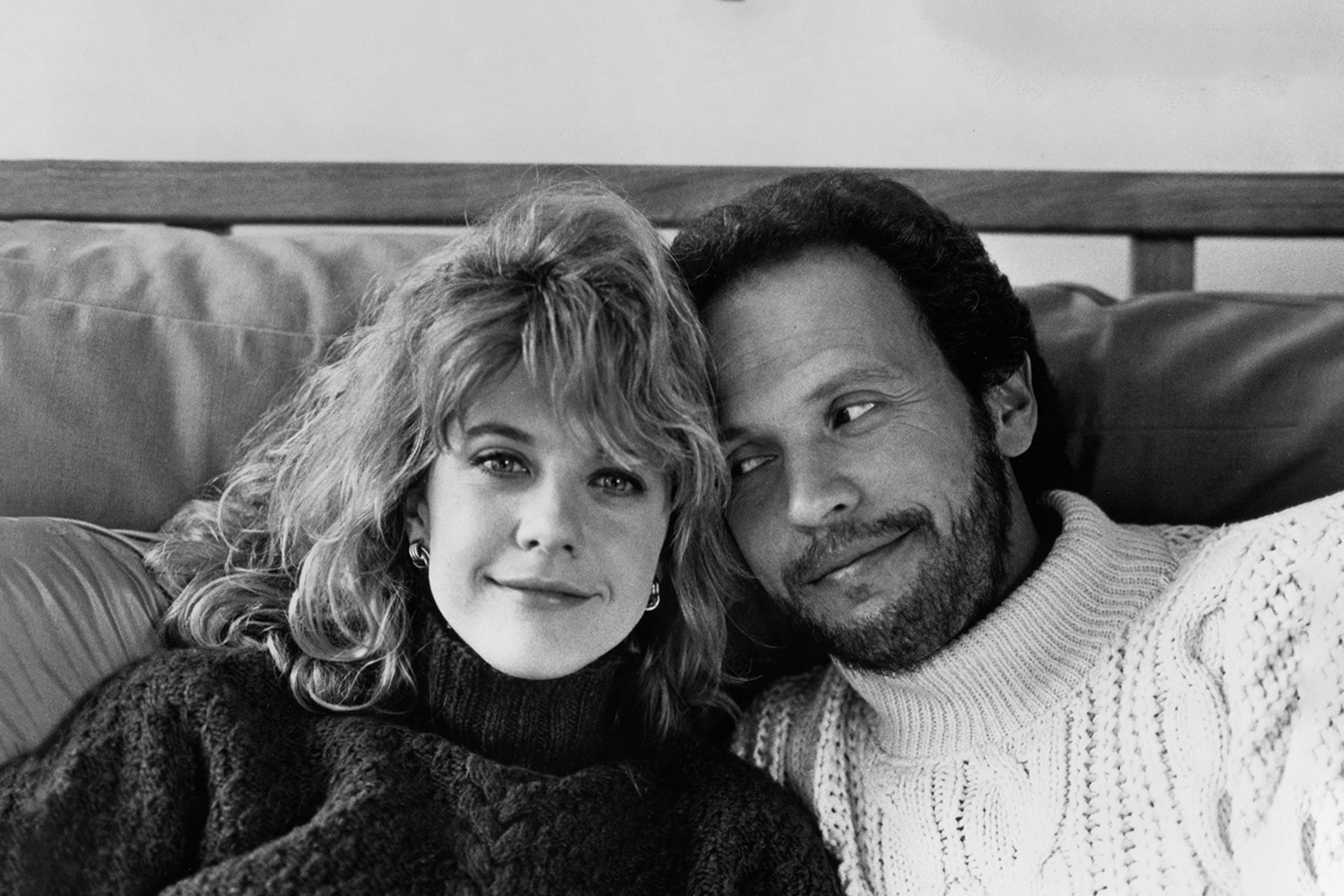
(Hulton Archive/Getty Images) Meg Ryan and Billy Crystal pose for the movie “When Harry Met Sally” circa 1989.
Harry’s speech is bold, yes. But, more than that, it’s urgent. Another moment without Sally by his side is a moment spent trudging through a world, lost in its darkness. In Sally, he’s found a light, someone who glows so brightly that she shines into the future, washing out all of its uncertainty.
Part of the genius of “When Harry Met Sally” is that, while the viewer wants the titular couple to end up together, their fate doesn’t feel guaranteed. Nothing in this life is, and until Reiner met and fell in love with Michele Singer, Harry and Sally’s love wasn’t, either. The film’s original ending was a bittersweet final meeting between two old friends, where, according to Reiner, the characters would eventually go their separate ways, still better off for having known each other. But for a film that was so heavily based on its real-life creators, anything less than idyllic would’ve felt wrong. Reiner suggested a simple confession of love at a New Year’s Eve party. Ephron wanted Harry to tell Sally exactly what he loved about her, down to the minute details. So, the two arrived at a final compromise: A combination of both that had plenty of romance for Sally and all of Harry’s no-frills straight talk.
Rushing to her side at the party, Harry finally tells Sally that he loves her. “You can’t just show up here, tell me you love me and expect to make everything alright,” she replies. “It doesn’t work this way.”
“How about this way?” Harry says. “I love that you get cold when it’s 71 degrees out. I love that it takes you an hour and a half to order a sandwich. I love that you get a little twinkle above your nose when you’re looking at me like I’m nuts. I love that, after I spend a day with you, I can still smell your perfume on my clothes. And I love that you are the last person I want to talk to before I go to sleep at night. And it’s not because I’m lonely. And it’s not because it’s New Year’s Eve. I came here tonight because, when you realize you want to spend the rest of your life with somebody, you want the rest of your life to start as soon as possible.”
Harry’s speech is bold, yes. But, more than that, it’s urgent. Another moment without Sally by his side is a moment spent trudging through a world, lost in its darkness. In Sally, he’s found a light, someone who glows so brightly that she shines into the future, washing out all of its uncertainty. But the couple would never get there together if one of them didn’t admit it. The fact of the matter is, the complex, demanding modern reality we’ve found ourselves in demands that we spend all of our time grieving impossible tragedies and overlooking new opportunities. Our hearts really do harden when we don’t keep them open, and the only way to keep them tender is to practice love, even when it feels radical or inconceivable. And as 2025 comes to a close on the heels of another catastrophe, there’s no better time to begin loving wholly and hard than the holidays, just as Reiner’s film encourages. If we want the rest of our lives to start as soon as possible — if we want a better life to start as soon as possible — why not start right this second?
Read more
about love stories