

All power that moves the progress needle in the United States begins with money and influence. This is why some very loud people were outraged at Bad Bunny’s selection to headline the Super Bowl LX halftime show months before he set foot on the turf at Levi’s Stadium in Santa Clara, California.
One such person is House Speaker Mike Johnson, R-La., who told Migrant Insider editor Pablo Manríquez shortly after the announcement broke wide in October, that the NFL had made what “sounds like a terrible decision in my view.” When Manríquez asked why, Johnson replied, “Well, it sounds like he’s not someone who appeals to a broader audience. And I think, you know, there’s so many eyes on the Super Bowl . . . a lot of young, impressionable children.”
Bad Bunny generates revenue on a level that affords him the power to insist on maintaining his culture instead of assimilating into whiteness.
What millions of kids saw during the intermission of Sunday’s match between the New England Patriots and the Seattle Seahawks was an all-ages street party thrown by one of the most famous and loved musicians in the world. Yes, the world — in 2025, he racked up 19.8 billion streams globally on Spotify according to its year-end stats, becoming the first artist ever to take the service’s top spot four times.
(Ishika Samant/Getty Images) Bad Bunny performs onstage during the Apple Music Super Bowl LX Halftime Show
Bad Bunny also made history last Sunday, when “DeBÍ TiRAR MáS FOToS” became the first Spanish-language album to win album of the year at the 2026 Grammys. This came after he snagged awards for best música urbana album and best global music performance for “EoO,” bringing his career Grammy haul to six. So far.
He generates revenue on a level that affords him the power to insist on maintaining his culture instead of assimilating into whiteness. That doesn’t mean his messaging to and about Puerto Rico and our nation’s Spanish-speaking population is closed to anyone who isn’t from the island.
The right’s biggest critique had to do with the promise that the entire performance would be delivered in Spanish, a history-making first. Their baseless concern was that it would alienate English speakers. What Bad Bunny proved instead is that rhythm and dance are unerring translators.
Bad Bunny’s 13-song playlist celebrated all who live in the Americas — North, Central and South. The dozens of dancers moving around him represented the multicultural fabric of the United States and Latin America, reminiscent of a celebration you’d see in New York, Chicago, Miami, Los Angeles, or any major city across the diaspora.
But the larger message from the man also known as Benito Antonio Martínez Ocasio is one of genuine international unity.
No doubt there are many Super Bowl viewers who, like Johnson or other leading members of this nation’s gerontocracy, had never heard of Bad Bunny or have been conditioned to fear him and his music.
And this is why Bad Bunny’s performance hit us squarely in our feelings. It announced that everyone is invited to his party. You only need to show up with open ears and hearts.
Even if this halftime show weren’t headlined by a Latino performer at a time when Immigration and Customs Enforcement agents are hunting brown people, there was no way that this Super Bowl could have been conflict-free, ideologically speaking, on its diamond anniversary.
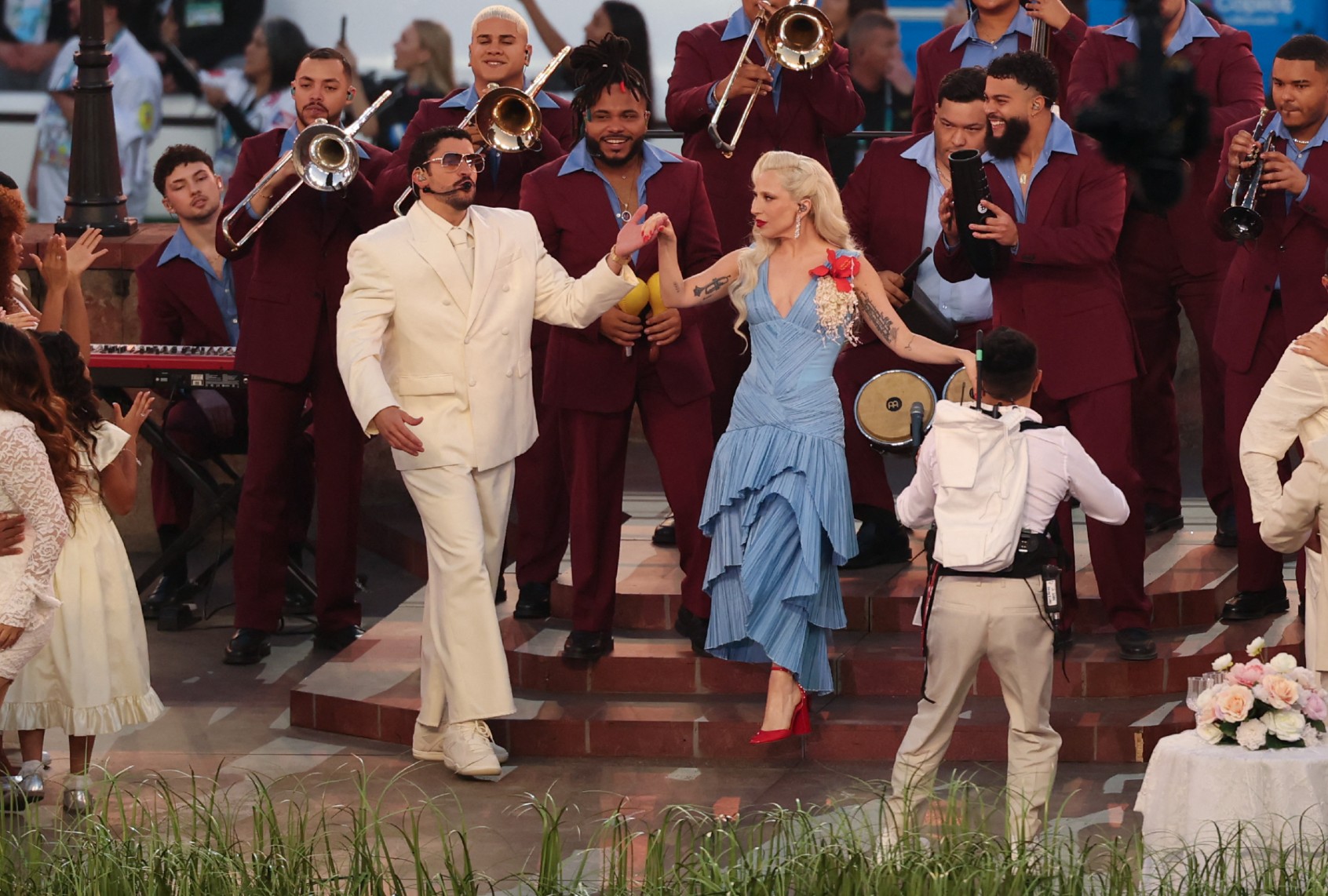
(Patrick T. Fallon / AFP via Getty Images) Lady Gaga and Bad Bunny perform during Super Bowl LX Patriots vs Seahawks Apple Music Halftime Show
Green Day set that tone earlier in the day with their performance. Sure, we also got Brandi Carlile singing “America the Beautiful” and Charlie Puth, one of the least objectionable people in showbiz, performing the National Anthem. Before Green Day, Coco Jones sang a stirring rendition of the Black national anthem, “Lift Every Voice and Sing,” backed by an eight-piece string ensemble.
But the Bay Area rock band best known for “American Idiot” announced itself by ripping into that album’s title track, an indictment of xenophobia and media manipulation, and “Holiday,” an anti-war anthem, along with its power ballad “Boulevard of Broken Dreams.”
Bad Bunny’s performance hit us squarely in our feelings. It announced that everyone is invited to his party. You only need to show up with open ears and hearts.
Some also noticed what appeared to be an Our Lady of Guadalupe pendant on the chain around lead singer Billie Joe Armstrong’s neck, wondering if he wore it as a gesture of solidarity with Latin Americans. That said, the band skipped “American Idiot”’s most politically heated lyrics while testing the censors by keeping the line about the “subliminal mind-f**k, America” intact.
Bad Bunny’s signifiers were subtler, although some may not have contained the meaning people read into them. At one point, the camera pushed close as the artist handed one of his Grammys to a grinning little boy. He was adorable and so reminiscent of Liam Conejo Ramos, the 5-year-old who was detained by ICE, that some social media accounts live-posting the event reported it was him.
This was quickly debunked. However, that this gesture was misinterpreted for a short time is an indicator of how desperate we are for someone with a platform to powerfully speak out against the tyranny seizing the United States.
It took Bad Bunny’s unambiguous declaration of “ICE out” at the 2026 Grammys for others to find their bravery. But it was the way he did it that previewed his Super Bowl achievement. “We’re not savage, we’re not animals, we’re not aliens,” he said during his acceptance speech. “We are humans, and we are Americans.”
“The only thing that’s more powerful than hate is love,” he added. “So, please, we need to be different. If we fight, we have to do it with love.”
On Sunday, he showed what that could look like.
In a football field lined with artificial sugar cane stalks, the performer strolled past men playing dominoes, a pair of sparring boxers, a shaved ice stand and a pawn shop case while singing his nightclub bangers “Tití Me Preguntó” and “Yo Perreo Sola.”
He eventually emerged on the roof of a casita identical to the one featured in his Puerto Rican residency’s set, one of two structures that served as stages and tributes to the island’s culture.
The other recreated a storefront thronged by smiling people moving to Bad Bunny’s beats. But before he headed there, he performed on his casita’s rooftop as Cardi B, Pedro Pascal, Jessica Alba, Karol G and other stars danced on its front porch. Midway through the set, a couple exchanged marriage vows.
Lady Gaga made a cameo to perform a few bars of “Die with a Smile,” delivered with a salsa kick.
Later, Bad Bunny reclaimed the spotlight to perform “El Apagón,” which translates to “The Power Outage,” his 2022 song lamenting the island’s failing power grid, which sustained catastrophic damage in 2017’s Hurricane Maria and has never been fully repaired.
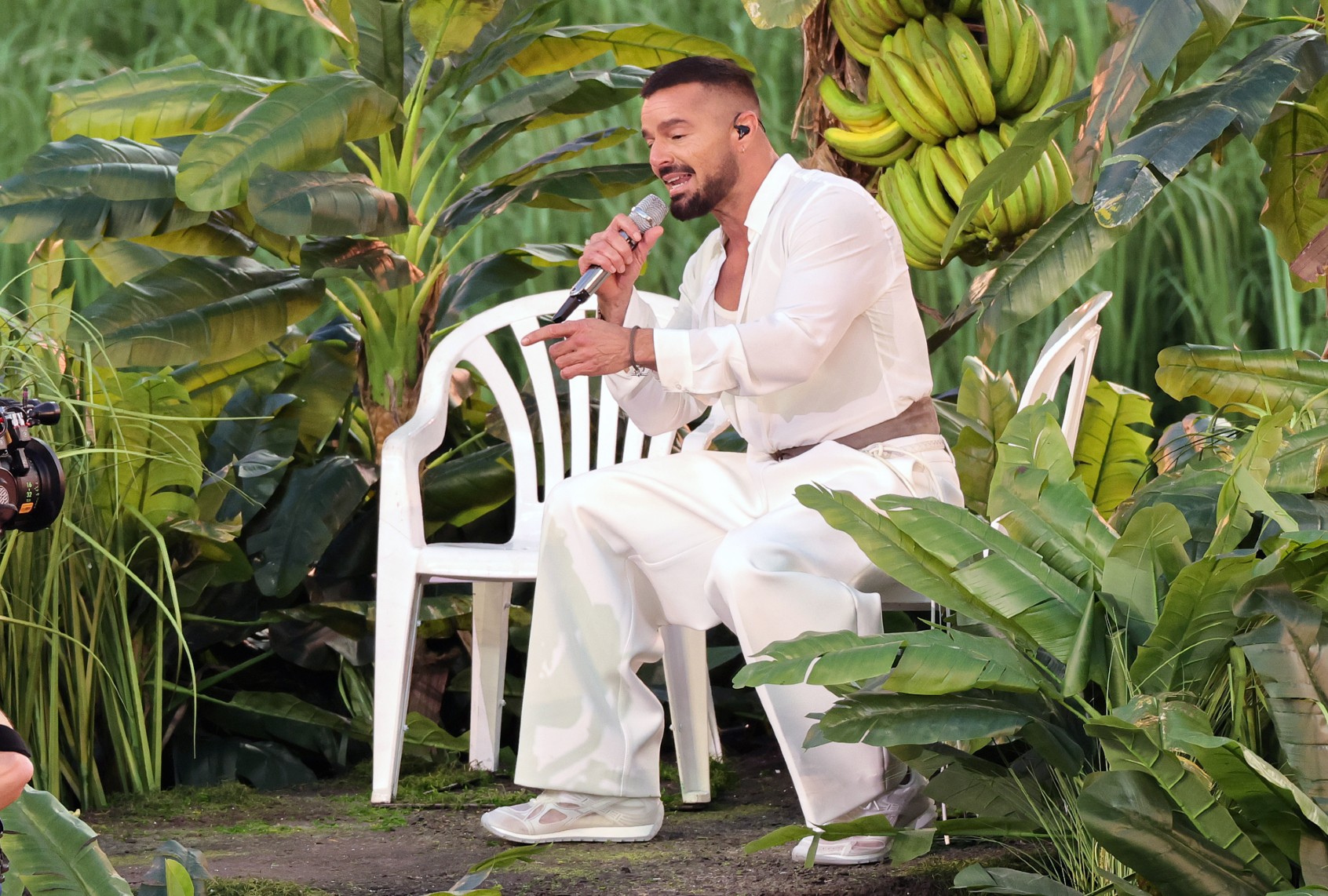
(Neilson Barnard/Getty Images) Ricky Martin performs during the Apple Music Super Bowl LX Halftime Show
This may have been the most overt art-as-protest moment, showing dancers climbing sparking electrical poles, only to fall off and dangle by what looked like snipped wires. But the performer’s most devoted fans understand that the entire set wrapped righteous critiques in a street carnival.
Ricky Martin covering “Lo Que Le Pasó A Hawaii,” for example, acknowledges white America’s admiration for the “Livin’ La Vida Loca” singer and the way we swoon for that tropical destination. The title translates to, “What Happened to Hawaii.”
A deeper reading unlocks the history of those islands as a warning against the gentrification that’s changing Puerto Rico and pricing out the people who have lived there for generations; it includes lyrics that translate to, “They want to take the river and the beach away from me, they want my neighborhood and my grandma gone.”
Conservatives absolutely feared this type of content, but mainly for the same reason they complained about Kendrick Lamar’s performance at last year’s Super Bowl: Its true meaning flew right over their heads.
Similar to the way Lamar’s performance was laden with symbolism about Black history, life and death under the American police state, Bad Bunny placed cultural tributes in plain sight. The many appearances of the pava hat signify solidarity with the island’s field workers. At another point, a giant monitor behind the action featured Concho, the singer’s crested toad mascot. Those amphibians are endangered due to habitat loss.
Conservatives absolutely feared this type of content, but mainly for the same reason they complained about Kendrick Lamar’s performance at last year’s Super Bowl: Its true meaning flew right over their heads.
Neither of these merit calls to the Federal Communications Commission, but past complainants griped about less. Of the125 objections related to Lamar’s halftime show, most had a problem with how Black it was. That didn’t prevent it from becoming the most-watched Super Bowl Halftime Show in history, drawing some 133.5 million viewers.
Sunday’s telecast may exceed that, which is precisely why Jay-Z, whose Roc Nation co-produced the performance with Apple Music, selected Bad Bunny. The NFL is expanding its footprint to host games in Mexico and Brazil, two countries where reggaeton, salsa and other música urbana styles dominate. Bad Bunny is good for business.
That was his reason for hosting his three-month residency in San Juan instead of on the mainland. If fellow Americans wanted to experience it, they had to visit Puerto Rico and contribute to the local economy. That they did, to the tune of an estimated $400 million.
Bad Bunny’s popularity proves that what is happening cannot be hypnotized away by visions of consumerist excess or glittering spectacle, or by ignoring the reality that many more people are moving to the same rhythm of inclusion and concord.
Want more from culture than just the latest trend? The Swell highlights art made to last.Sign up here
Coincidentally, Jay-Z’s name came up in the recent Epstein files dump: In a February 2014 email to Jeffrey Epstein from banker Jes Staley, the former Barclays CEO suggested that America’s billionaires needn’t fear a working-class uprising like those in Brazil experienced in 2013.
“You want to know why we are not Sao Paulo? Watch the TV ads on the Super Bowl. It’s all about hip blacks in hip cars with white women,” wrote Staley. “The group that should be in the streets has been bought off by Jay Z.”
The powers that be have nothing to fear from Bad Bunny, specifically. They should be concerned about the growing number of Americans — many more than simply Black, brown, Indigenous and other non-white people — who are beginning to wake up and see the truths Benito Ocasio is singing about.
The only words of English Bad Bunny spoke in his entire performance were as it ended: “God Bless America,” he said, before listing the multitude of countries comprising Latin America, as well as Canada and the United States.
Behind him, a digital billboard bore the sentence, “The only thing more powerful than hate is love.” The superstar wrapped by holding up a football emblazoned with, “Together we are America,” before bounding off the field as the crowd joined him in singing “DtMF,” regardless of whether they know what the words mean.
Read more
about this topic


