

A dark comedy is only as successful as its bleakest jokes. Exploitation is not inherently funny, and there’s a vast difference between a movie that earns your laughter and one that expects a certain reaction. For a film to be funny without losing its edge — or worse, feeling intentionally edgy — a punchline has to be both smart and unexpected. The audience should be taken by surprise and realize, in the middle of their laughter, just how truly clever the joke is, causing them to laugh even harder.
There’s one such joke in “The Drama” I can’t stop thinking about, a perfectly timed and shrewdly written gag that has made me laugh out loud every time I’ve thought about it over the last 10 days. Like the film’s central narrative diversion, it occurs early in the movie, but could be considered a spoiler for those still trying to avoid pivotal details before seeing the film themselves. (If that’s you, bookmark this for later.)
After a few too many glasses of wine while approving the catering selections for their upcoming wedding, bride-to-be Emma (Zendaya) reveals a troubling secret to her fiancé, Charlie (Robert Pattinson), and their friends, Rachel (Alana Haim) and Mike (Mamoudou Athie). Until this moment, both the audience and the characters in the film understand Emma to be a funny, easygoing young woman. That’s why it comes as a major shock when she admits to everyone around the table that, as a teenager, Emma planned a school shooting, going so far as to practice with a rifle and bring the weapon to school before deciding against it. The confession results in confusion and anger erupting like molten lava from all sides, instantly corroding Emma’s bond with Charlie and her relationships with their friends. The next day, Charlie and Emma begin discussing the circumstances that preceded her plan — depression, bullying, the black hole of the internet — before pausing for an appointment. They’ve got to meet their wedding photographer to plan setups. This is no time to talk about gun violence.
(A24) Zoë Winters in “The Drama”
Borgli’s film demonstrates that a certain level of ambiguity and discomfort allows for complex conversation. “The Drama” demands discomfort before defying it, making for a sophisticated viewing experience that questions our instinctual judgments.
Cut to the studio where their photographer, Frances (Zoë Winters), is outlining the plan. “First, I’ll shoot you,” she begins. “Then I’ll shoot your parents. I’ll shoot the maid of honor, then get some shots of the reception. I’ll shoot the wedding guests. Then I’ll shoot the grandparents.” It’s a brilliantly edited joke, a bit that puts the “punch” in “punchline.” It’s also funny because it’s uncomfortable. Writer-director Kristoffer Borgli hops from a grave, life-changing conversation between a couple on the brink of destruction to an outrageous setup that doesn’t make light of the tense subject matter, but rightly toys with the audience’s unrest. A laugh is what we need in this moment, and it’s because Borgli diffuses some of the tension that he’s able to rebuild it again over time, atop a stronger foundation of trust between the filmmaker and his audience. The viewer has reckoned with their unease by finding humor in an otherwise unfunny topic. Now, talking about the prickly subject at the film’s heart will be that much easier. As if to pat himself on the back, Borgli buttons the joke when Charlie responds that his grandparents might not be able to make it to the ceremony. “OK, shooting grandparents TBD,” Frances responds with a big smile.
Want more from culture than just the latest trend? The Swell highlights art made to last.Sign up here
That “The Drama” can employ such a sharp string of laughs before pivoting back toward earnest commentary on the gun violence epidemic without alienating the viewer should not be overlooked. The film has managed to become the toast of the internet, with users across social media actually talking to each other, rather than over one another, about the movie’s themes. Americans spend so much time entrenched in silent fear and anxiety about the violent nature of the country. The opportunity to actually engage with the multitude of conditions that may incite that violence feels unique and desperately needed.
But that reaction hasn’t been universal. “The Drama” has proven controversial and has been criticized as too thinly written by some viewers and critics who want answers and meaning laid out in legible, didactic lessons built into the script. But Borgli’s film demonstrates that a certain level of ambiguity and discomfort allows for complex conversation. His movie expands on films of a similar nature, finding a sweet spot where themes of empathy, forgiveness, brutality and grace can be discussed with the attention they deserve. “The Drama” demands discomfort before defying it, making for a sophisticated viewing experience that questions our instinctual judgments.
Oddly enough, “The Drama” was already resisting knee-jerk reactions before it was even properly released. After an early version of the script made the rounds online, TMZ got in touch with Tom Mauser, whose son, Daniel, was killed in the 1999 shooting at Columbine High School. In a comment to the outlet (if you can call them that; I’d go with “rag”), Mauser — who hadn’t seen the film, but saw Zendaya speaking about it on “Jimmy Kimmel” — told TMZ he believed the film could “normalize” shootings and “humanize” mass murderers. On April 2, the day before “The Drama” was released in theaters, the gun violence prevention organization March for Our Lives issued a statement criticizing A24 for “deeply misaligned” marketing, citing trailers that depicted the film as a dark rom-com while concealing the extent of Emma’s horrible secret from the public.
Diminishing the hurt from people who have been directly affected by gun violence is a useless, cruel task. But it is worth noting that “The Drama” burrows into the subject in a way no other film, especially one so widely appealing, has managed to. The film examines the environments that foster and encourage violence: online echo chambers in the form of edgelord message boards and Tumblr blogs, and real-life settings where bullying and isolation are free to fester. The severity of Emma’s teenage plan is analyzed against the kind person she’s proven herself to be as an adult. Slowly, love stretches into the past, shining light on a dark adolescence. Forgiveness and regret intertwine.
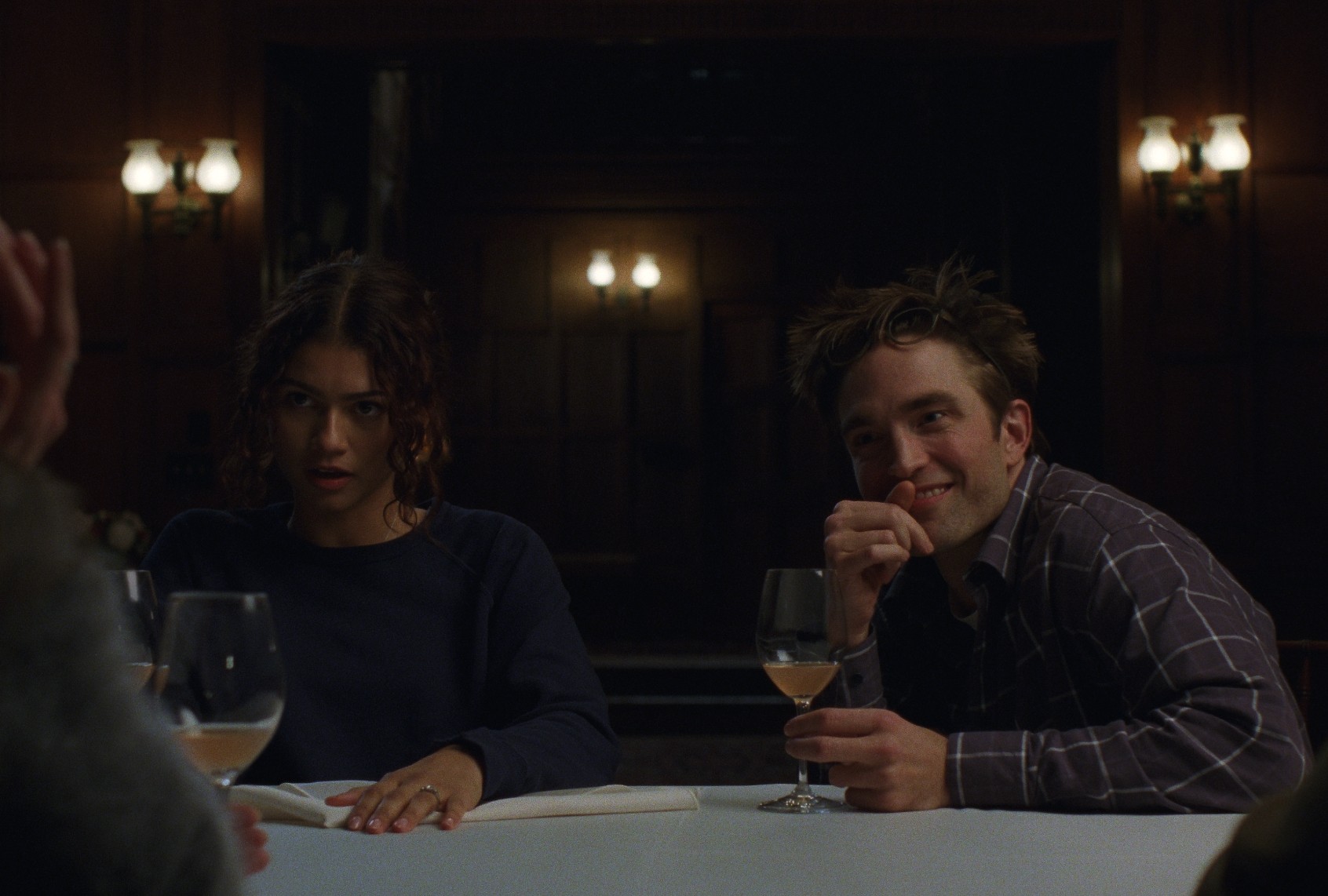
(A24) Zendaya and Robert Pattinson in “The Drama”
“The Drama” contemplates thorny matters, but it’s not satire. It encourages the audience to think, but it doesn’t force their disgust for empty provocation. It reminded me of two similar films that deal in extremity and, on their face, look like inflammatory cinema until picked apart and examined more closely.
Before his Oscar-nominated epic “The Brutalist,” Brady Corbet’s previous decades-spanning drama, 2018’s “Vox Lux,” divided audiences. The movie, about the survivor of a school shooting whose aching lament rocks the nation and catapults her to a life of pop stardom, is just as questionable as “The Drama” might seem to an outsider. But watching the film — and, be warned, its depictions of violence are far more graphic than any implications in “The Drama” — one will find that Corbet is covertly critical of the gun violence epidemic, while still portraying its repercussions. “Vox Lux” questions how and why we prop up survivors, the tools (or lack thereof) society gives them, and if we sanctify them to absolve our helplessness. All of these queries have merit, and the only way to begin answering them is to push through the discomfort that comes with having these conversations at all.
In Gus Van Sant’s 2003 film, “Elephant,” the pupils and faculty of an Oregon high school go about their days while two students plan to carry out horrific acts of violence. The movie is directly inspired by the Columbine massacre, and ruminates on the banality of a day that can end in tragedy. Like “The Drama,” it scrutinizes its characters’ violent motives, but stops short of civilizing their savage intent. Only a few years removed from Columbine, Van Sant’s movie was only beginning to make sense of the senseless. It tried to address the thin line between humanity and barbarity with unsettling realism, hoping that the film could encourage discussions by, as Roger Ebert put it at the time, “draining violence of energy, purpose, glamor, reward and social context.” Drawing a throughline between all three films, “Elephant” was posing questions that “The Drama” intends to answer.
“The Drama” understands that violence thrives in darkness and that the fear of being judged is what keeps those experiencing difficult, extreme emotions from talking about them. It takes an exceptional piece of art to inspire audiences to think twice about what comes as second nature, to choose compassionate contemplation over ardent debate.
One main issue with the automatic, inevitable hubbub with films about school shootings is that, whether we want to admit it or not, Americans are desensitized to gun violence. By the very nature of where we live, we have to confront these realities every day. The sheer number of mass shootings that happen in this country every day forces our emotional response to dull, lest we make ourselves crazy trying to compute the extent of the brutality no human should ever have to perceive. But films about this specific form of gun violence provide audiences who have otherwise had to bury their grief with the chance to reckon with the reality. The cinema is a place where new ideas sprout and beliefs are forged. When “The Drama” prioritizes grace over judgment in the temple of the movie theater, people will listen.
Having seen “The Drama” in theaters twice, what astounds me is witnessing the audience’s open-mindedness. Initially, I expected the film to be more immediately controversial among the public. But to my great surprise, the conversations surrounding the movie, both online and in-person as viewers exited the auditorium and spoke with their friends outside the theater, have been thoughtful and nuanced. Conversely, critics have been the ones quick to deem the film mere sensationalism, seemingly clinging to preconceived notions about how certain themes should be talked about within the medium. Some have rejected the film as flimsy satire; others have wanted its message to be edgier and more obvious.
Even after two viewings, I can’t seem to wrap my head around those myopic professional readings, especially as someone who often finds himself wishing everyone would take a bit more time to think before posting their opinion. An opening weekend audience will rarely engage with the film on a more considered level than someone whose job it is to sift through the layers, someone who’s supposed to approach movies with good faith to search for depth that may or may not be present. No film will make everyone happy, but I can’t imagine a world where audiences would be as excited about a version of “The Drama” that spells its messaging out plainly. The people don’t just want discomfort; they enjoy it. They learn from it. We all do.
Discomfort is paramount to our vulnerability. Sitting in unease and acclimating to its extreme temperature — refusing to fight our very nature — is one of the most impactful things we can do for our bodies and minds. Ironically, such unpleasantness can inspire as many calm, intelligent chats as “The Drama” already has. Maybe one could surmise that people have gotten tired of heated discourse, that they’re bored by arguing. But we live in a world where instant condemnation is taught and incentivized. In fact, that’s part of what “The Drama” is all about, and what it’s warning against. Borgli’s film understands that violence thrives in darkness and that the fear of being judged is what keeps those experiencing difficult, extreme emotions from talking about them. Everyone can pass judgment, and it’s critical to analyze how we wield such power. It takes an exceptional piece of art to inspire audiences to think twice about what comes as second nature, to choose compassionate contemplation over ardent debate. Movies shouldn’t tell us how to feel, but they should give us the tools to come to our own conclusions. Good, bad or completely incomprehensible, “The Drama” has done just that.
Read more
about movies that will challenge you


