


At Monday night’s Met Gala, where the dress code was the highly interpretable yet laughably vague “Fashion Is Art” — spun from the Met Costume Institute’s spring 2026 exhibition, “Costume Art” — stars strolled the green carpet gussied up in looks inspired by the works of great sculptors, painters and photographers. Hunter Schafer wore a lovely Prada gown inspired by Gustav Klimt’s “Mäda Primavesi.” Troye Sivan channeled photographer Robert Mapplethorpe in tousled hair and designer jeans. Nicole Kidman showed up in a red sequin dress because she “wanted to embrace the way in which red has been used in art through the years.” They can’t all be knockouts.
Rubbing elbows with the glitterati was former journalist, children’s book author, and occasional explorer of the cosmos, Lauren Sánchez Bezos, who, alongside her husband, Jeff Bezos, bought her way into the function for a cool (reported) $10 million. The hefty price tag made Sánchez and Bezos the lead sponsors of the exhibition and gala, and scored them the title of honorary chairs, shoehorning in their names alongside Kidman, Venus Williams, Anna Wintour and Beyoncé.
(Kevin Mazur/MG26/Getty Images for The Met Museum/Vogue) Jeff Bezos and Lauren Sánchez Bezos attend the 2026 Met Gala celebrating “Costume Art” at the Metropolitan Museum of Art
To ascend the Met steps, Sánchez Bezos wore a navy blue Schiaparelli gown with a pearl and crystal strap falling from one shoulder, evoking one of the most significant works in the museum’s collection, John Singer Sargent’s portrait of Parisian socialite Virginie Amélie Avegno Gautreau, “Madame X.” Originally painted with one strap languidly falling from the shoulder, Sargent’s portrait created a stir in late-1800s Paris. Critics fixated on Gautreau’s reputation for vanity and sexual impropriety decried the portrait as oversexualized and wilfully provocative. Sargent later repainted Gautreau with both straps fixed to her shoulders — a needless compromise between the artist and those who wielded the power to dictate beauty.
“Madame X” was seen as Sargent’s calculated attempt to drum up attention, and Gautreau’s aim for the kind of legitimacy that sitting for one of Paris’ great artists could afford. In other words, the painting’s story isn’t so different from the one that preceded the union of Mr. and Mrs. Bezos.
Sánchez Bezos’ choice to reference “Madame X” is both knowing and blithely oblivious. “For me, [“Madame X”] represents how fashion and cultural standards can shift over time,” she told Vogue in a chat before the gala. “Today, a strap is a strap, but back when ‘Madame X’ was painted by Sargent, a strap was a scandal.” Although she doesn’t mention the correlation directly, Sánchez Bezos is almost certainly aware of her own status as a scandal-maker, whose every decision has been met with extreme scrutiny since she began dating her now-husband. Although her Schiaparelli look is more like “Madame B” for “Boring,” especially at an event like the Met Gala, it’s at least a somewhat interesting — if self-satisfied — commentary. But the reason it’s really intriguing is buried between the lines, nestled in a place I’m not sure even Sánchez Bezos can see.
Gautreau, who married into money with a man twice her age, was notorious among Parisian society for her rumored infidelities. Just as whispered-about were her beauty and her body, enhanced by hourglass silhouettes and lavender powder to accentuate her fair skin. Like many in Paris, Sargent was fascinated by Gautreau and asked her to sit for him. But when their portrait debuted to derision, “Madame X” was seen as Sargent’s calculated attempt to drum up attention, and Gautreau’s aim for the kind of legitimacy that sitting for one of Paris’ great artists could afford. In other words, the painting’s story isn’t so different from the one that preceded the union of Mr. and Mrs. Bezos.
Like Gautreau, Sánchez Bezos has been criticized for brandishing her wealth to gain access to circles she might not have otherwise run in, flaunting excess in a moment when almost everyone outside the 1% is grappling with economic disparity and inflation. And at the same time, the Bezos’ hefty contribution to the Met’s Costume Institute goes a long way in making the organization self-sufficient. With the Met Gala raking in a record $42 million this year alone, curator Andrew Bolton says the Costume Institute is on track to have an endowment large enough to sustain its day-to-day operations by 2030, preserving a public good for the millions of people who visit the museum every year. But is that larger good deed also setting an unsavory precedent for how art and wealth will be forced to comingle in the future — will the public have to depend on the rich and powerful to spare the things that should be protected simply because they’re worth saving?
That’s one of the questions at the heart of “The Devil Wears Prada 2,” a film that, no question, was deliberately released during the first week of May to capitalize on some of the buzz surrounding the Met Gala. The long-awaited sequel finds the Anna Wintour stand-in, Miranda Priestly (Meryl Streep), in a position far more precarious than she stood at in the first film. In 20 years, the days of long-haul, on-location fashion shoots with Richard Avedon and months-long in-depth reporting have become all but a distant memory, replaced by clickbait-adjacent articles and content made to live and die on the Runway magazine app. The sequel’s tone is starkly different from the original film; it’s far less of an evergreen fashion fantasy than a timely drama, charting a course through the media and art world’s murky futures. Much like Wintour, Bolton and so many working in media, Miranda and her cohorts go up against a handful of billionaires who have the power to decide Runway’s fate. And while the results don’t exactly foretell a happy ending, they spin an eerily accurate yarn about what the years ahead may look like for anyone who hopes to hold onto the human-made beauty that’s quickly slipping through our fingers.

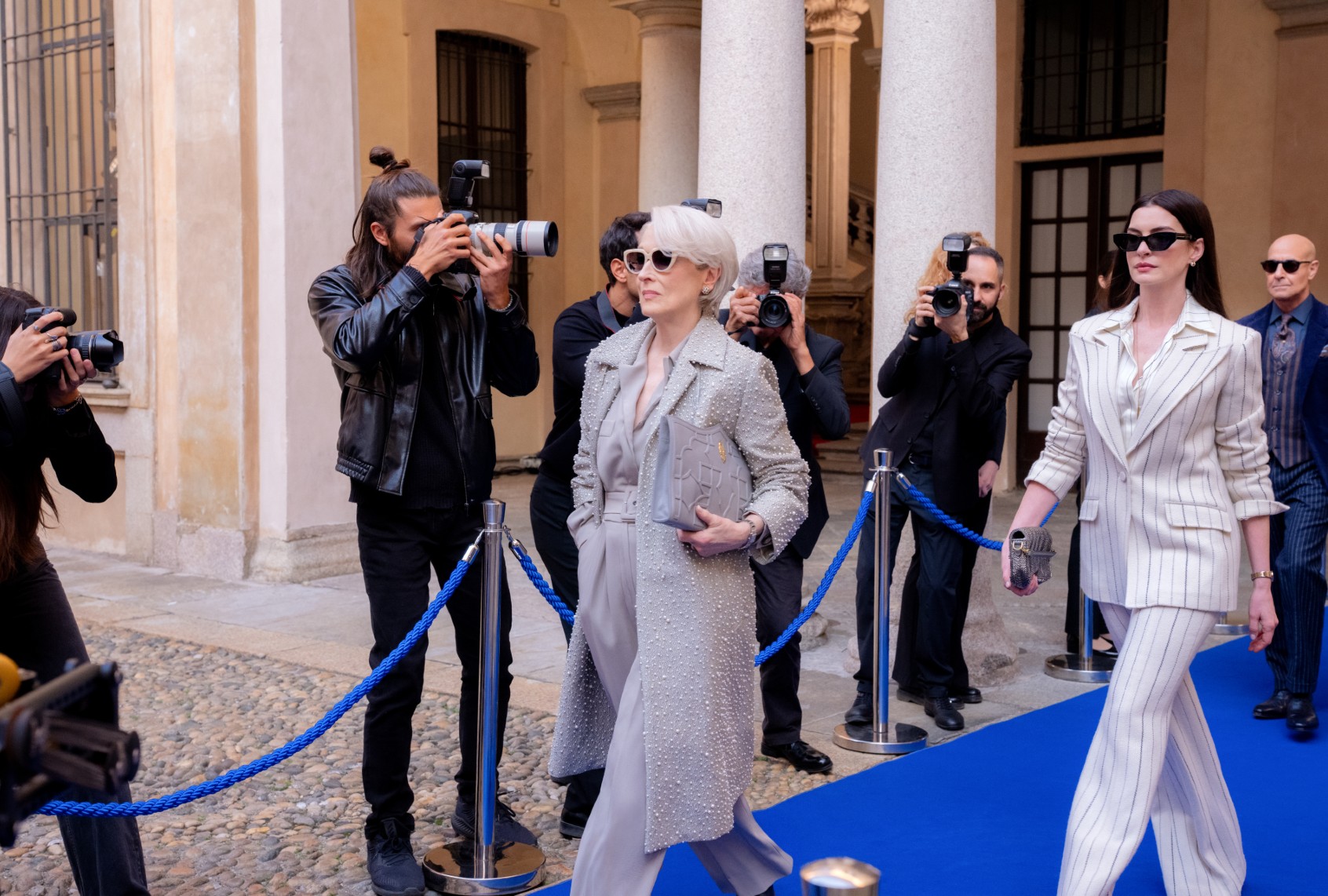
(Macall Polay/20th Century Studios) Meryl Streep as Miranda Priestly and Anne Hathaway as Andy Sachs in “The Devil Wears Prada 2”
Once the final voice in every decision, Miranda is now wedged between a rock and a hard place — completely new, slightly discombobulating territory for viewers who have spent the last two decades becoming intimately familiar with the character’s commanding persona. Not only has a slew of HR complaints tempered her icy remarks, but slashed budgets and declining readership have forced her hand. The magazine can no longer survive on its name alone. Runway must find ways to appeal to readers and capture their attention in an economy fighting for eyes every second. When a scandal rocks the magazine at the top of the film — on the night of Runway’s own annual gala benefit, no less — a call comes down from the top of Runway’s publisher, Elias-Clarke. Soon enough, Andy Sachs (Anne Hathaway) strolls back into Miranda’s office, just as plucky and brimming with ideas as she was fresh out of college, now with the power to implement them.
But fixing Runway’s problem won’t be that easy. In media, a great new hire or a hard-earned bit of reader goodwill are just fresh bandages placed over a wound that must be constantly treated. When a tragedy befalls Elias-Clarke and a new CEO is tapped to take over, it’s not just Miranda who’s in trouble, but Runway and its publisher’s storied legacy, too. And even though Andy’s tenure at the magazine has boosted readership and restored some of the magazine’s credibility, it’s not enough to ward off the vultures circling Runway, ready to sink their talons into this piece of legacy media to use its name for their distorted, artless visions.
Want more from culture than just the latest trend? The Swell highlights art made to last.Sign up here
In its choice to abscond with so many of the glamorous elements that made the first film so adored in favor of business jargon and anxious conversations about the state of media, “The Devil Wears Prada 2” firmly asserts its belief in the public. Audiences aren’t coming to this film solely because it’s a legacy sequel. Viewers remain curious about fashion and journalism. They want the insider scoop over these worlds that still capture our imaginations, propelling them into new and fantastical places while keeping us grounded in human creativity. These viewers also deserve to know the truth about what’s going on behind the curtain, a reality that looks quite unlike it did in 2006. How are their favorite publications, the ones they used to pore over as curious teenagers and idealistic young adults — or even just purchased to entertain themselves during a particularly long layover — changing without their knowledge? Who’s pulling the strings, and what purpose do their machinations serve?
Make no mistake, “The Devil Wears Prada” is a significant part of why the Met Gala has become the cultural sensation that it has, why Vogue was able to spend the years following its release building September issues bigger than a phone book.
In “The Devil Wears Prada 2,” this role belongs to Benji Barnes (Justin Theroux), a tanned and touched-up billionaire who could prove to be Runway’s guardian angel — for a price, of course. The film spends significant time roasting inane eccentrics like Benji but not without explaining their place in the media’s modern ecosystem. They’re people with enough money to buy a company outright just because they want a pet project. They’re venture capitalists who swoop in to save drowning publications with a life raft, only to paddle away with half the publication on board, and the other half left to tread water and say a prayer. A billionaire buying a fashion magazine is akin to a plane hurtling toward the ground, only for a passenger to confidently take the controls, despite having zero flying experience.
Perhaps Lauren Sánchez Bezos, what with her pilot’s license and all, could be a saving grace? Last summer, rumors swirled that Jeff Bezos was toying with buying Vogue, and possibly Condé Nast, for his bride as a wedding present. Acquiring one of the largest and most renowned publishers would certainly give Condé’s titles a welcome influx of cash that could restore the magazines to their glory days. But it would also allow unprecedented control to someone entirely unfit to run a magazine, let alone understand its readers. What’s more, it would provide either one or both of the Bezoses the ability to put the editorial kibosh on anything they deem unfit to print, while shoehorning their own interests into the publication. Say goodbye to all of the smart, varied journalism Vogue has pivoted toward over the last decade, and hello to articles about the sexiest stilettos to wear while orbiting the Earth next to a washed-up pop star.
That’s something Miranda Priestly has no interest in if she can help it. As the film rolls on, “The Devil Wears Prada 2” astutely reminds viewers of exactly what’s at stake when billionaires get a little too cozy with art. Meeting with one of Runway’s prospective buyers, Miranda stresses that, although things may change, the magazine must maintain its commitment to beauty and human artistry, the same principles it’s held for over 100 years — the ones that had a major hand in making the first film such a massive hit. “The Devil Wears Prada” was a heaping dose of wish-fulfillment, but it was also the very movie that carefully and artfully elucidated the values of magazines and fashion, emphasizing the art form of both. Make no mistake, the film is a significant part of why the Met Gala has become the cultural sensation that it has, why Vogue was able to spend the years following its release building September issues bigger than a phone book. Commerce always fraternized with art and journalism in the magazine business, and Miranda needs to hear that this balance will stay if the magazine changes hands. When the buyer’s answer isn’t good enough, Miranda is forced to find another way for Runway to forge on, amid the deafening sound of a ticking clock.
In the end, Miranda can only buy more time. The solution looks good for now, but she and Andy know that change could come at a moment’s notice, and they could once again be thrust back into preservation mode. The answer to their problem still comes with sacrifice; they’re still at somebody else’s whim, even if that somebody has promised to be hands-off. The tastemakers of media have been forced to find a way to please themselves, their audience and the people whose money keeps the entire operation afloat, and it’s a far more difficult, unprecedented task than it used to be.
While that doesn’t seem like an entirely hopeful vision to wrap up a sequel, “The Devil Wears Prada 2” blends its pragmatism with a healthy amount of optimism, too. There may be a way to make this work, to find sustainable answers to keep media alive through the fire and help readers understand why the price of a magazine subscription will do far more for them than the price of ChatGPT Plus.
Back at the Met Gala, things don’t seem so sure. The Bezos’ involvement was met with boycotts and protests. Despite being a charity benefit, it was, to many, a repugnant display of wealth, sponsored by a couple whose surname is synonymous with poor working conditions, genocide and the growing class disparity. But maybe in some twisted reality, their donation really was a move of pure benevolence, and not a blatant way to worm their wealth into another facet of our everyday lives. To Vogue, Sánchez Bezos recalled her first time walking the Met’s halls, admiring hundreds of years of careful curation and preservation, saying, “I remember standing in the galleries thinking, ‘Oh my gosh, somebody saved this. Somebody decided that this mattered.’”
Whether or not she meant it this way, she’s got a point: The people making the decisions about art should be the ones with enough relevant experience to know what they’re doing.
Read more
about films contending with our changing world