


“A great new sound reaches us, always, as a miraculous gift.”
The rock critic Dave Marsh, now of blessed memory, wrote that about Albert Ayler in 1998, and out of the thousands of memorable words Marsh wrote about music, that one stands out as perhaps the best declaration of his own personal creed.
Dave Marsh was born in Flint, Michigan, where his dad worked on the railroad and did not appreciate the length of his son’s hair or the music he listened to. He left home as soon as he could, and later dropped out of Wayne State University to help start CREEM, where he was a founding editor. He later went on to write for everybody: Rolling Stone, Musician, Billboard, Long Island’s Newsday, Boston’s The Real Paper, the aforementioned Addicted To Noise, the short-lived Record. This is not a complete list.
This is not an obituary, but instead an attempt at an homage from someone who would not be sitting here writing these words were it not for his work.
He launched his own publication, Rock & Roll Confidential, which was later renamed Rock & Rap Confidential. It was a deliberate and visible acknowledgment that Marsh did not view rap in the pejorative sense that far too many of his colleagues and music fans did — and still do. He wrote 22 books, countless liner notes, and hosted three radio shows on Sirius XM: “Live from E Street Nation,” “Live from the Land of Hopes and Dreams,” and “Kick Out The Jams.” He was a voracious reader and an even more voracious listener, for whom genre was of no concern.
Marsh passed away on August 15 at the age of 76. This is not an obituary, but instead an attempt at an homage from someone who would not be sitting here writing these words were it not for his work; his encouragement and his friendship came later. By now you may have read many other similar pieces. They all likely point to his groundbreaking work as an actual pioneer of the genre, his endless support of up-and-coming writers, his voracious musical appetite, and his passion for talking about, debating, and arguing over music.
It is the latter that most of his friends tend to remember; it wasn’t so much that Dave wanted you to think his way (although he wouldn’t necessarily mind if you did), but instead, I always felt, the pushback was a genuinely Socratic exercise designed to make sure that you had considered all of the necessary data points before forming your own opinion. At the end of the conversation, Dave still might think he was right, but he’d still respect you even if he thought you were wrong — as long as you could defend that wrongness.
(Ebet Roberts/Redferns/Getty Images) Music critic Dave Marsh
He was willing to update and correct his own thinking, and working and reading and writing towards the end of understanding himself and how he felt and thought about all of this. He did, indeed, take it too seriously.
If you were never in the position of being forced to think on your feet because you said something in front of Dave Marsh that he then proceeded to interrogate you on, he demonstrates this thought process in his 1981 masterwork, “The Book of Rock Lists.” (It is out of print, but available used in copious quantities in the usual locations, and you can also visit it for free on the Internet Archive.) If you think this volume was a throwaway effort, think again: it is 640 pages long. I read it cover to cover multiple times and you’d be surprised how it filled in many holes in the rock history residing in my then 17-year-old brain. It was originally intended as an antidote to the accusations that Marsh and his colleagues took rock ‘n’ roll too seriously, a charge which this book does not dissipate, but it is consistently hilarious, and is still worth a read.
Towards the back of the tome, there’s a chapter where the authors dispense with the jokes and get down to the serious business of ranking “not 100, but 1,000 crucial” rock ‘n’ roll singles and about 600 albums. In a paragraph outlining the evaluation process and criteria, they wrote:
“Those who have read the morass of information contained in this volume will naturally understand that the omission of ‘Never Mind the Bollocks, Here’s The Sex Pistols’ is ultimately trivial, since every rational man and woman of our times has already purchased this classic, or made an equally objective decision not to.”
That quote has lived in my head since I read it for the first time in 1981. Of course you bought this groundbreaking record, or you made the decision that it wasn’t for you. Marsh always assumed that you’d made the decision, or at least within the community of people who also took everything that surrounded music criticism and fandom “too seriously.”
There’s also a second volume of rock lists, which is not as solid as the first one, and I’ve always viewed Marsh’s 1989 project “The Heart of Rock & Soul: The 1001 Greatest Singles Ever Made” (also out of print, also on the Internet Archive) as the true successor to the first list book. What’s absolutely fascinating, and totally on-brand, is how Marsh contradicts, criticizes and updates himself between the various books. He was willing to update and correct his own thinking, and working and reading and writing towards the end of understanding himself and how he felt and thought about all of this. He did, indeed, take it too seriously.
Want more from culture than just the latest trend? The Swell highlights art made to last.Sign up here
In the early pages of “The Heart of Rock & Soul” book, he writes about how he was still having second thoughts: “Looking back a few weeks after finishing the manuscript, I tremble at my own weak grasp of latter-day funk, fret about what I’ve left out. Friends ask after their favorite records and if they’re not here, even I wonder why.” And he also notes that even though he’s just written 634 pages (not including appendices and the index), that he wasn’t attempting to be definitive: “. . . it’s an attempt to jump start a stalled dialogue, a discussion that offers a possible, necessary alternative to the familiar din. An alternative. Not the only possible one. The one I know how to argue for.”
Was it good music? That’s what was at the heart of what Marsh cared about. Were the songs good? That’s the first question he’d throw out, especially when debating things like whether a band should or shouldn’t be in the Rock and Roll Hall of Fame, where Marsh was part of the nominating committee for decades. He and I argued specifically about the Velvet Underground’s initial absence from the Rock Hall for a very long time, including live on one of his radio shows, where he was gracious enough to invite me on multiple times to talk about something I’d written or because he thought I might have something interesting to say.
I first began seeking Marsh’s byline after I’d read his profile of Patti Smith in Rolling Stone (“Her Horses Got Wings, They Can Fly”) in 1976. At the time, he was the first person who wrote about her in a way that didn’t make me feel grossed out. Specifically:
“Then she got pregnant. The circumstances don’t matter—she was in junior college at the time—but she had the baby without getting married and gave it up for adoption. Teenage pregnancies weren’t uncommon in South Jersey; in fact, they are just the sort of thing which happens to normal, well-adjusted girls everywhere.”
It was an early and remarkable demonstration of Marsh’s working-class roots — a thing he never disowned — as well as his feminism. There wasn’t a lot of that around in rock critic circles in the 1970s (or ’80s or ’90s or —)

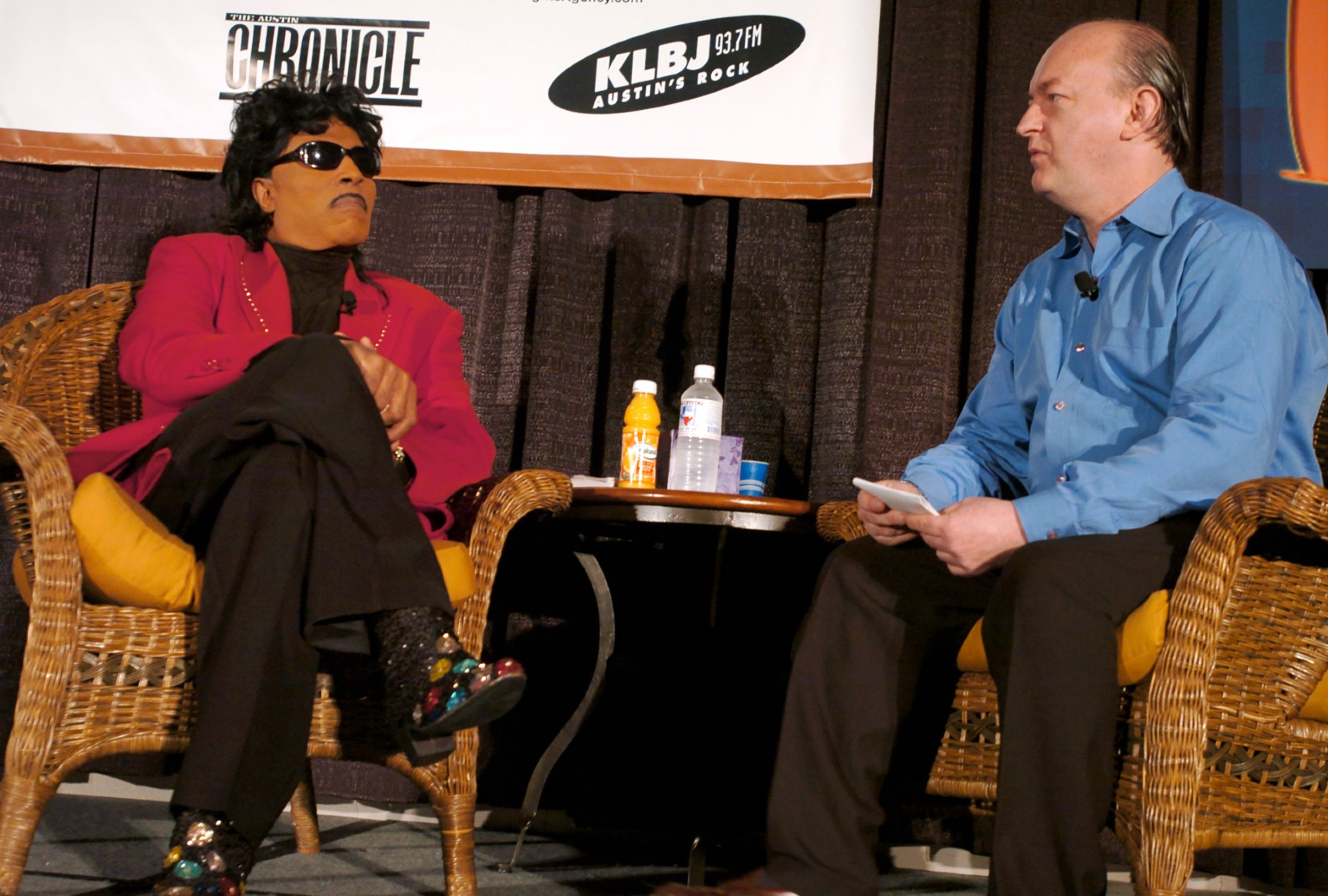
(John Anderson/The Austin Chronicle/Getty Images) Little Richard and music critic Dave Marsh
After reading Marsh’s profile on Smith, I backtracked to specifically seek out his writing in ancient issues of CREEM and more recent issues of Rolling Stone. When he published the first book about Bruce Springsteen (the first book to use the title “Born to Run,” also on the Internet Archive because it is also out of print), it was a revelation. He wasn’t working overtime to pretend he didn’t love this music exactly as fiercely as the rest of us punters. But it was also the first writing about Springsteen I’d read that helped me figure out how I felt about those records at age 15. It also showed me a larger, broader landscape and a way of thinking existed, not just for Springsteen, but for all of the other music I was listening to.
I met Marsh in person when his publisher sent a copy of his Who biography to my college newspaper (shoutout to the Fordham Lincoln Center Observer) and the accompanying letter noted that “the author was available for interviews.” The thought that I’d get to talk to the human who made me think I could get a journalism degree and maybe do what he did overpowered any trepidation I had to make that phone call.
Was it good music? That’s what was at the heart of what Marsh cared about. Were the songs good? That’s the first question he’d throw out, especially when debating things like whether a band should or shouldn’t be in the Rock and Roll Hall of Fame, where Marsh was part of the nominating committee for decades.
When I showed up at his apartment building for the interview, he’d left a note with the doorman to join him down the street at a restaurant, where he was having lunch with a friend who was a British journalist. (I wish I could remember who it was, but that has vanished with the sands of time.) They spent the meal discussing Marsh’s book on Elvis, and Marsh went into detail about everything he’d learned about Elvis Presley’s dietary habits.
I was a sophomore in college who’d written a handful of things maybe worth reading, but Marsh treated me like a peer and a colleague. After the meal, we sat down for my interview and some deep, heartfelt discussion about the Who, a band that we both loved with the same intensity and fervor. And when I left, Marsh told me I should send him my clips. I would send the work I thought was my best, and I knew he read them, because he’d often send them back with scribbled notes and comments.
And then there was the day I picked up the “Rock & Roll Confidential” book and found my name in there, with a comment about something I’d written.
The only reason I paid attention to this particular situation and its implications was because Marsh’s work taught me to pay attention, to think larger, to insist that it all mattered.
A place where Marsh and I remained in cordial disagreement across the decades was in my continued affection for U2, despite Marsh’s consistent belief that Bono was absolutely full of sh*t in terms of his many political activities, including being chummy with war criminals and speaking for Africa without their permission (among other transgressions). Hanging out at the bar at the Merrion Hotel in Dublin back in 2007, Bono asked Dave what he was working on, and he responded with, “The premise that celebrity politics has been a pretty much complete failure.”
Bono challenged Marsh to a debate on this subject not once but twice, and Dave invited him to come on his radio show. Bono agreed, and then six months later, he backed out. (You can read Marsh’s accounting of the incident in his Rock & Rap Confidential here; it’s also included in the most recent anthology of Marsh’s work, “Kick Out The Jams: Jibes, Barbs, Tributes & Rallying Cries,” which came out in 2023.) In 2025, when Mr. Hewson felt the need to appear on Joe Rogan’s podcast, my first reaction was: “Dave Marsh was right.” Among my many regrets is that his illness meant that I didn’t have the opportunity to tell him that.
The other piece of Marsh’s I returned to over the years was his infamous tour diary on the 1975 Rolling Stones tour, titled “I Call and Call and Call On Mick.” As Marsh relates in his introduction to the piece in the 1985 anthology of his work, “Fortunate Son,” he’d just joined the staff of the magazine, and when Joan Didion and her husband (seriously) backed out of the assignment, Marsh got the nod. As he notes, “Rolling Stone covers a Stones tour with the same sensibility that the daily press brings to a presidential campaign, which means minutely detailed coverage without ever touching on the larger issues . . . Consequently, sending me on this junket was asking for multiple kinds of trouble.”
It’s not exactly a spoiler that Marsh wasn’t a huge Stones fan, nor to relate that Marsh does not get his interview with Jagger, but his piece still provides a fascinating and detailed look into the tour, reporting on the kinds of details that other writers with a similar charge would overlook. “A half-hour of hard-driving rock led straight into mid-tempo sludge like ‘Fingerprint File,’ a pointless but not purposeless exercise whose supposed function was to prove that Jagger could play guitar competently.” (He is not wrong.) It’s still amazing that the magazine printed it anyway. (I’d love to see the first draft he filed.)
My last quote is a humblebrag for sure, from an email in 2012 where I hyped up the Wild Flag album to him, and he replied:
“You are the only person I know who could get me to listen to a Sleater-Kinney spinoff. But I will. Now that you’ve told me to.”
My remembrances of Dave Marsh aren’t special or unique, and I’ve left out so much. But that’s the greatest tribute of all, isn’t it: that when you leave the planet, there’s a long line of people waiting to tell their stories about you. Rest in power. Kick out the jams.
Read more
from music columnist Caryn Rose