

Brazilian firefighters walk outside the venue for the COP30 U.N. Climate Summit, Monday, Nov. 10, 2025, in Belem, Brazil. Fernando Llano/AP
This story was originally published by Grist and is reproduced here as part of the Climate Desk collaboration.When Christine Peringer attended her first United Nations climate conference in 2019, she was not exactly impressed. As a professional facilitator and a member of Mediators Beyond Borders International, she said she was “appalled” by the “lack of sophistication in their methods of running the meetings.”
She described the typical rigmarole: First, delegates gather for a plenary session, where they can deliver surface-level position statements about some draft text prepared by the conference’s chair. Then they break out into small groups and “just start working things out very quickly,” with people agreeing or objecting as they go—sometimes they talk over one another, sometimes they fail to translate interjections into non-English languages. It gets worse in the final hours, when delegates crowd around a single sheet of paper, making revisions in ink.
“I don’t know how they come up with anything in such a haphazard process,” Peringer said.
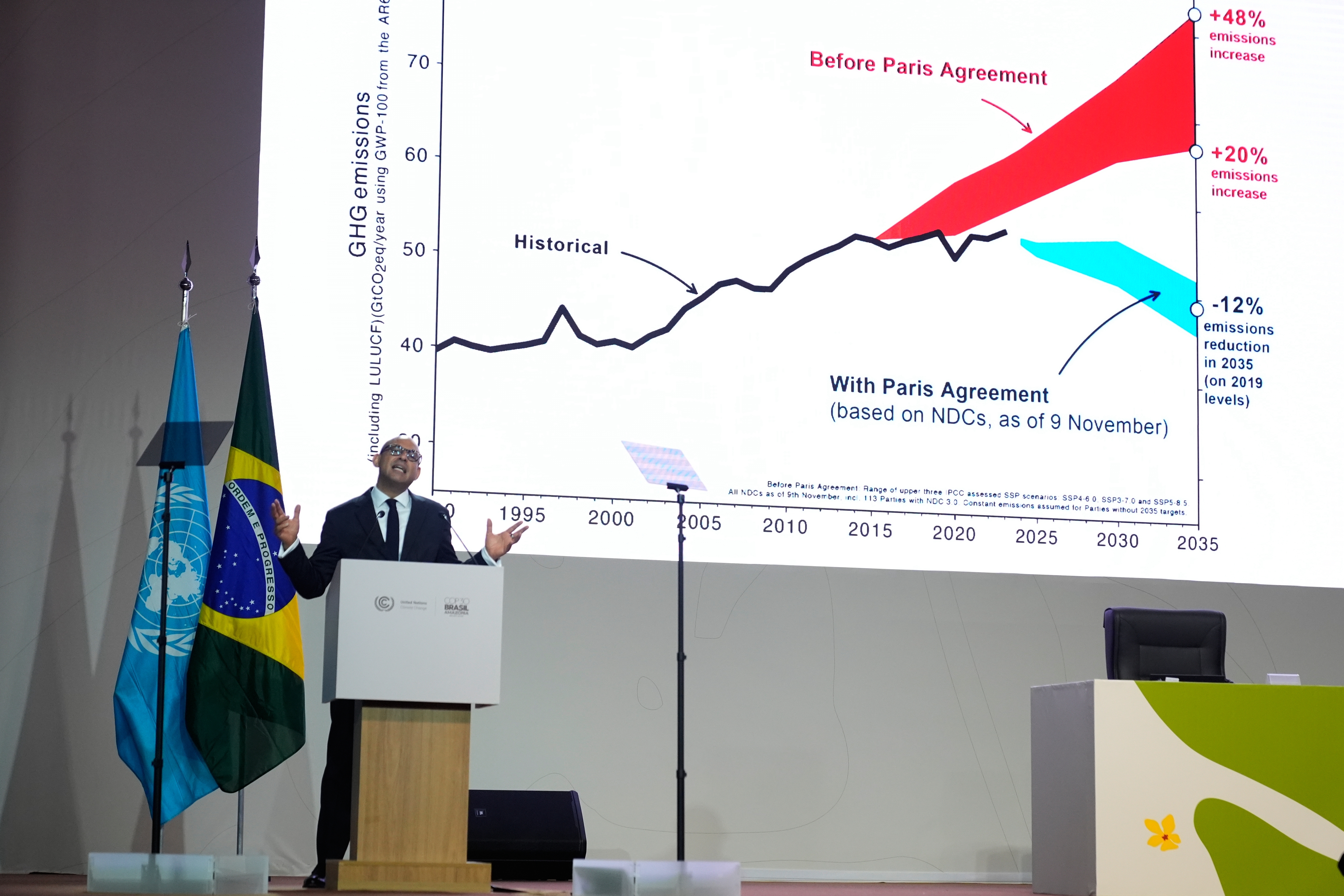
Peringer’s experience is typical of those attending the U.N.’s annual climate negotiations, known as COPs (for “conference of the parties”), which have been going on for more than 30 years and aim to align global efforts to combat climate change. The dysfunction has had consequences: Since the early ’90s, annual greenhouse gas emissions have grown by 40 percent, despite the climate pledges made under the Paris Agreement, which was itself a product of COP21 in 2016. No country on Earth has a climate pledge in line with the agreement’s 1.5 degrees Celsius (2.7 degrees Fahrenheit) target, according to the collaborative research project Climate Action Tracker; instead, the pledges made by countries a decade ago are projected to cause up to 3.1 degrees C (5.6 degrees F) of warming.
Many other observers have called the conferences “broken,” “mayhem,” and a “circus,” and each year, there are calls for reform. These range widely, from banning fossil fuel lobbyists at the negotiations to limiting opportunities for greenwashing.
One mundane procedural issue stands out, however: voting. Due to the concerted efforts of oil-producing countries like Saudi Arabia, participants in the United Nations Framework Convention on Climate Change, or UNFCCC—the treaty that kicked off the yearly COP negotiations—are unable to vote on contentious issues. Instead, they have to pursue consensus, giving every country a de facto veto power over proposals they don’t like. Environmental groups have called this a “poison pill” that has undermined climate progress for decades. Many are trying to stop it from sullying other international environmental agreements, like the UN plastics treaty.
Now that COP30 in Belém, Brazil, has kicked off, the question is once again rearing its head: Should the negotiation’s participants be able to vote? Mads Christensen, Greenpeace International’s executive director, wrote in September that a lack of voting was “at the heart” of the COP’s paralysis: The conferences must “push ahead with science, justice, and majority voting to ensure progress,” he said. Christiana Figueres, one of the architects of the Paris Agreement, made a similar suggestion in August. But it’s not clear whether this is possible, or the extent to which it would actually resolve the climate treaty’s problems.
It’s unusual that the UNFCCC precludes voting. Most UN bodies, including its General Assembly, Security Council, and Economic and Social Council, allow voting in at least some circumstances. The same is true of several other U.N. environmental treaties, like the Stockholm Convention.
The difference with the UNFCCC is that oil-producing countries blocked the adoption of the agreement’s “rules of procedure” way back in 1991—the part of the treaty that lays out its decision-making protocols. Saudi Arabia, Kuwait, and their allies objected to a mundane provision allowing two-thirds majority voting as a “last resort,” once efforts to achieve consensus had been exhausted. On the advice of US-based climate denial groups, they insisted that the treaty’s decisions be made by consensus only.
Since then, the rules of procedure have only been provisionally applied to the annual climate conferences, with the text about voting cordoned off in brackets to indicate that it hasn’t been agreed to and thus can’t be used. Formally adopting the rules of the procedure to allow voting would, ironically, require consensus, due to the rules of the United Nations. According to Joanna Depledge, a research fellow at the University of Cambridge’s Centre for Environment, Energy and Natural Resource Governance, “adoption of the rules of procedure” is now the longest-standing unresolved item on the COP agenda.
“There is something to be said for saying, ‘We want everyone on board.’ But what we see is really just a stalling of progress.”
“I would say that the climate regime has settled into a kind of routine,” Depledge said.
There are benefits to consensus. Incorporating every country’s viewpoints gives decisions greater legitimacy and makes it more likely that they’ll be adhered to and enforced. The Paris Agreement, for all its flaws, had such a high level of buy-in because of the decade of negotiations preceding it, in which delegates haggled their way toward a universally acceptable outcome.
But these are benefits of a consensus-building process, not necessarily of consensus itself. Most UN treaties, even those with voting, recognize this and ask countries to always seek the broadest level of agreement before putting something to a vote.
“The only reason consensus works is because there is a threat of a vote,” said Melissa Blue Sky, a senior attorney with the nonprofit Center for International Environmental Law.
The Basel Convention, for instance, has successfully reduced the international trade of hazardous waste—like discarded electronics—largely by consensus. Likewise, with the Stockholm Convention, which rarely actually uses voting but has still been able to phase out a number of toxic pesticides. Other treaties that allow voting but don’t often use it include the 2013 Minamata Convention, which aims to protect people and the environment from mercury, and the 1987 Montreal Protocol to prevent the destruction of the ozone layer, which didn’t vote on anything until 2016.
When differences are irreconcilable, however, voting allows a way forward, as demonstrated earlier this year by the International Maritime Organization. More than 60 countries voted to approve a new target for reducing the shipping industry’s greenhouse gas emissions, overcoming opposition from 16 countries and abstentions from 24. (A vote to officially adopt the regulations was delayed for another year, however, after interference from the Trump administration, which is opposed to them.)
Delegates to the climate COPs understand the unfortunate dynamic they’ve gotten themselves into. The countries that don’t want strong climate policies—mostly those with a significant fossil fuel sector—see a huge advantage from consensus. Because they’re OK with the status quo, they can simply refuse to compromise on key “red lines” and just wait for the rest of the world to compromise instead. The former president of the Maldives put it well during COP17 in 2011 when he said that “two parties reach an agreement, a third one comes along and says it doesn’t agree and it reduces the ambition of the others.” He called the negotiating process “stupid, useless, and endless.”
A diplomat from Bangladesh expressed a similar sentiment during COP27 in 2022: Consensus was leading to “lowest common denominator” outcomes, and any decision reached on this basis would be “so weak, so ineffective that it is not going to be anywhere near the challenges of today.”
There have been some attempts at reform. During COP17 in 2011, Mexico and Papua New Guinea submitted a creative proposal to amend the UNFCCC, rather than its rules of procedure. This would have circumvented the need for consensus; changes to the UNFCCC can be made by a three-fourths majority vote. But the idea never got enough support to move forward, and it has remained on the subsequent conferences’ provisional agendas.
At another conference, in 2013, a procedural issue led Russia to request a legal review of the UNFCCC’s decision-making processes. This was placed on the agenda for COP19 and could have been an opportunity to bring up voting rules, but it never was discussed.
Depledge, with the University of Cambridge, thinks the Mexico-Papua New Guinea proposal or another one like it is the most likely path to voting at the COPs—she said it would be “nigh on impossible” to ever adopt the rules of procedure outright. Earlier this year, she wrote an op-ed suggesting that new voting rules should require a supermajority or a double majority of developed and developing nations. “We should have voting rules, and they should be deployed as much as possible,” she said. She is, however, skeptical that this will be sufficient to change the trajectory of global climate action. A lack of voting “is not the number one reason why we are not achieving as much as we could be.”
Depledge added that the voting issue is unlikely to come up in Belém, due to geopolitical issues—President Donald Trump’s assault on international institutions, war in Gaza and Ukraine—and related questions around the future of international climate diplomacy itself.
The experts Grist spoke to were hesitant to predict how past climate negotiations would have been different had negotiators been able to vote. But one could imagine stronger language around a “phaseout” of fossil fuels, rather than a “phase-down,” or stricter requirements for wealthy countries to lend money and other resources to poor countries that have done little to cause global warming yet are suffering the most from its consequences. Going forward, COP30 and future meetings might yield stronger collective commitments to ratchet up emissions reductions, even if they’re not legally binding and mostly serve as a “norm-setting” function for the rest of society.
Short of trying to introduce voting rules, Peringer, the professional facilitator, thinks future climate conferences should reinterpret consensus. Instead of conflating consensus with unanimity—meaning the enthusiastic, affirmative agreement of all parties—what if consensus meant that each country could simply “live with” a given decision?
“You only block consensus if you really believe that this is, like, so detrimental to the whole process, or in opposition to values that are held dear,” she said.
In an academic paper elaborating on this idea in 2023, Peringer suggested that COP facilitators should play a more active role in determining when consensus has been reached, and then asking any holdout countries to “stand aside” in the interest of the larger group. There’s already some precedent for this within climate negotiations, notably from COP16 in 2010. In order to adopt a package of decisions called the Cancún Agreements, then-COP president Patricia Espinosa overruled a last-minute objection from Bolivia, saying that “consensus does not mean that one country has the right of veto, and can prevent 193 others from moving forward.”
Of course, it takes a skilled and confident facilitator to do something like that, and many of the recent COP presidents have not demonstrated this leadership ability. Plus, the tactic is less likely to work if there’s a larger group of countries blocking consensus.
One risk of moving away from the consensus decision-making model is that countries may feel alienated from the UNFCCC or Paris Agreement. If they’re overruled in an important decision, they may choose to simply opt out and walk away. This would obviously affect the treaty’s efficacy, since those countries most likely to leave are those with the deepest commitment to continuing to use oil, gas, and coal.
But to Erika Lennon, a senior attorney with the Center for International Environmental Law, the risks could be worth it. Oil-producing countries are already not participating in good faith, she said, and other nations are watering down their own ambitions to accommodate their delaying tactics. She and Blue Sky said they’re open to smaller coalitions of countries working at a much more ambitious level to phase out fossil fuel products, and using trade policy to influence other nations that refuse to get on board. This is an approach that has increasingly been floated in the context of the U.N. plastics treaty, which also lacks a voting mechanism and has similarly been plagued by delay tactics from petrostates.
At least one other international treaty, the Ottawa Treaty, followed this trajectory. After failed attempts by the UN to negotiate a ban on land mines, Canada launched its own process to hammer out an agreement in the late ’90s. The Ottawa Treaty now has more than 160 signatories, though several have recently withdrawn in light of Russia’s war in Ukraine.
“There is something to be said for saying, ‘We want everyone on board,’” Lennon said, referring to global climate negotiations. “But what we see is really just a stalling of progress…and the consequences of it are measured in people’s lives or livelihoods and in the destruction of potentially whole countries.”


