

More than 25 years after reality television changed how TV is made and watched, America seems to finally be approaching a reckoning with the products of the time after the impact of CBS’s “Survivor” sent networks scrambling to get something — anything — that might match its ratings on air. Competition series that debuted in the first 6 years of the 21st century set the template for the thousands that followed, establishing the adventure-competition show (“Survivor,” “The Amazing Race”), the dating-competition show (“The Bachelor,” “Temptation Island”), the transformation show (“What Not to Wear,” “Extreme Makeover”), the smart-money show (“The Weakest Link,” “The Apprentice”), the creative competition (“Project Runway,” “Top Chef” ) and more.
Those who side-eyed the premises and ethics of these shows and the fast-and-loose version of “reality” they presented might feel validated by recent reconsiderations like Emily’s Nussbaum’s “Cue the Sun: The Invention of Reality TV” and the Netflix documentary “Fit for TV: The Reality of The Biggest Loser.” (The streamer’s “Reality Check: Inside America’s Next Top Model” drops Feb. 16th.) But despite knowing how the reality sausage gets made — shoddy working conditions, psychological manipulation, constant surveillance — the genre still anchors TV’s food pyramid. The shows debuting in 2026 include revived IP that hope to recapture the magic. Maybe that’s possible — but the first out of the gate, “Fear Factor: House of Fear” is a case study in how badly a throwback reality premise lands in an actual reality that’s fragmented beyond repair.
(Serguei Bachlakov/FOX) Contestant Kristen in “Fear Factor: House of Fear”
“Fear Factor: House of Fear” is a case study in how badly a throwback reality premise lands in an actual reality that’s fragmented beyond repair.
The original “Fear Factor” was known for two things: making Joe Rogan a thing and a notorious carelessness regarding participant safety. This is likely why “House of Fear” aims to be a friendlier reset. Exhibit A is its host, Johnny Knoxville, whose low-budget, gonzo “Jackass” was the goofball progenitor of “Fear Factor”’s juiced-up aggression. Exhibit B is the shift in format: Rather than two contestants per show facing challenges tailored to specific fears like heights and snakes, the reboot offers up a “Big Brother”-ish twist in which 14 competitors live together. Strategic sharing of their respective fears as they team up on a range of challenges allows for alliances and underminings that, so far, are more amusing than engrossing. (One competitor, in a confessional shot, admits that his biggest fear is mayonnaise — or is it?)
In theory, “House of Fear” has potential. The home as a living site of our worst nightmares has been made for stunning, high-concept horror in recent years; watching the competitors move into an isolated modernist pile in the Pacific Northwest, I was intrigued to see how fears built into their immediate environment itself might come to life. A controlled first-floor blaze that requires everyone to escape via a perilous roof? Meal prep that involves trying to locate ingredients in a refrigerator full of spiders? A no-holds-barred 3 a.m. showdown with toilet rats?
Three episodes in, there’s no sign of that. The challenges are staged in nearby areas, while the house is used for sleep, sh*t-talking and visits to the First Look Room, where the winners of each episode’s first challenge preview the next one via cheesy AI-generated clips. Announcing the network’s acquisition of IP for both “Fear Factor” and “The Weakest Link,” Fox president Michael Thorn told The Hollywood Reporter that the former “[Is] visceral storytelling at its best.” On one count, he’s correct: It’s definitely visceral.
“Fear Factor” became most famous not for its inspiring vignettes of regular people overcoming their fears, but for ingestion challenges that aimed to make everyone — competitors, host, crew and home audience — experience their most recent meal in reverse. These generally weren’t about fear; having to eat a horse’s rectum is simply not something that occurs with enough frequency to become a common phobia. They were queasy spectacles meant to test exactly how much degradation participants would withstand in pursuit of a cash prize. And they helped make abjection critical to the success of reality TV as a genre.
“House of Fear”’s first gross-out challenge takes place in the second episode, when each competitor spins a big wheel to determine what combination of disgusting solid and fetid liquid they must knock back as quickly as possible. Knoxville is in his element blending up these tall glasses of torment, wearing a bow tie and ribbing the housemates with perverse delight about the unholy drinks. He cheerfully warns them that if they throw up, their glass will be refilled — unless they throw up into the glass, in which case all they need to do is drink that to complete the challenge.
Want more from culture than just the latest trend? The Swell highlights art made to last.Sign up here
We’re far enough along in reality TV’s lifespan to know that the slabs of legal paperwork contestants sign ensure that the production is indemnified against any injury, sickness or mental and physical effects suffered by players. Rogan apparently didn’t sign one of these in “Fear Factor”’s first iteration, because he’s talked both on his podcast and in his stand-up about the things he couldn’t believe people on the show were asked to do, and has emphasized that he signed on as host because he assumed the show would be canceled immediately.
Who knew that convincing American television fans that money is a balm for harm and humiliation, that you can’t trust anyone, that the best way to get ahead is to be as ruthless and amoral as possible and that cooperation and fairness is for suckers would eventually lead to a nation governed by people who expect Americans to be pacified by money.
“Fear Factor’”s disinterest in differentiating fear from disgust always came across as mean-spirited and meant to make viewers at home laugh uncomfortably at the humiliation that was central to these competitive gross-outs. As a host, Knoxville is never mean-spirited or contemptuous in the way Rogan often was. Still, the gleeful sadism of “House of Fear” arrives at a perilous moment — one in which horror and humiliation aren’t things meant to shock us from the safety of our living rooms, but the defining feature of an actual reality that we can’t turn off.
The original show was released into a charged environment of post-9/11 bloodlust, a ginned-up war and the eventual exposure of the U.S. military’s torture of detainees at Iraq’s Abu Ghraib prison. Just as the crassness of “Fear Factor” should, as Variety put it in a 2001 review, “make NBC brass cringe with embarrassment,” the sadistic images that emerged from Abu Ghraib of American troops posing with thumbs up behind naked detainees forced into stress positions and human pyramids should have flattened the second Bush administration. Instead, the photos became part of the prevailing trend of torture porn and joined reality TV in ushering in an age of humilitainment.
(Serguei Bachlakov/FOX) Contestant Blake in “Fear Factor: House of Fear”
What former Salon critic Matt Zoller Seitz called “emotional blood sport” was the engine of reality programs in nearly every genre, but competition shows were the most relentless. On Fox’s repellent “The Swan,” that meant promising so-called ugly ducklings full surgical makeovers, putting them through grueling workouts and, immediately after their reveals, making them compete against one another in a beauty pageant. On NBC’s “The Apprentice,” it involved giving would-be entrepreneurs access to Donald Trump’s alleged business acumen in what a Wall Street Journal op-ed called “a game of musical chairs at a Hooter’s restaurant where sexual baiting and pleading is confused with effective salesmanship.” On “American Idol,” recalls media critic Jennifer L. Pozner, it often took the form of extended pre-interviews of young, low-income, mothers describing their dream of winning the competition so they could give their kids a better life — “and, of course, after this huge buildup we see them singing off-key and walking off the set to a “Benny Hill” soundtrack.”
Pozner, the author of 2010’s “Reality Bites Back: The Troubling Truth About Guilty-Pleasure TV,” arguably the first full-length book to look at the business of reality television, thinks of the years between 2001 and 2006 as formative not just for proofs of concept, but for communicating what it meant to be a viewer: “The cruelty of these shows groomed audiences to not only accept but to prioritize a sense of superiority — we would never subject ourselves to this; these people knew what they were signing up for and they deserve what they get.”
The big lie of reality television was that networks were giving people what they wanted, when in fact they were mostly trying to maximize their profits with shows that didn’t require the investment into writers, actors and production values of scripted series. Who knew that convincing American television fans that money is a balm for harm and humiliation, that you can’t trust anyone, that the best way to get ahead is to be as ruthless and amoral as possible and that cooperation and fairness is for suckers would eventually lead to a nation governed by people who expect Americans to be pacified by money, encourage them to distrust those around them, and convince them that cooperation and fairness are for suckers?
As Nicolaus Mills wrote in a 2004 piece for Dissent, “At a time when the . . . debate over the economy should be about the race to the bottom that is occurring as a result of the outsourcing of middle-class jobs and the growing number of families without health insurance, the worst possible television culture is one that tells us empathy has no place in our lives.” Television isn’t necessarily to blame for easing the rise of individuals, corporations and institutions that have operationalized lack of empathy. But it is absolutely complicit in stuffing our screens full of hollow, cynical content and telling us they only did it because we wanted it.
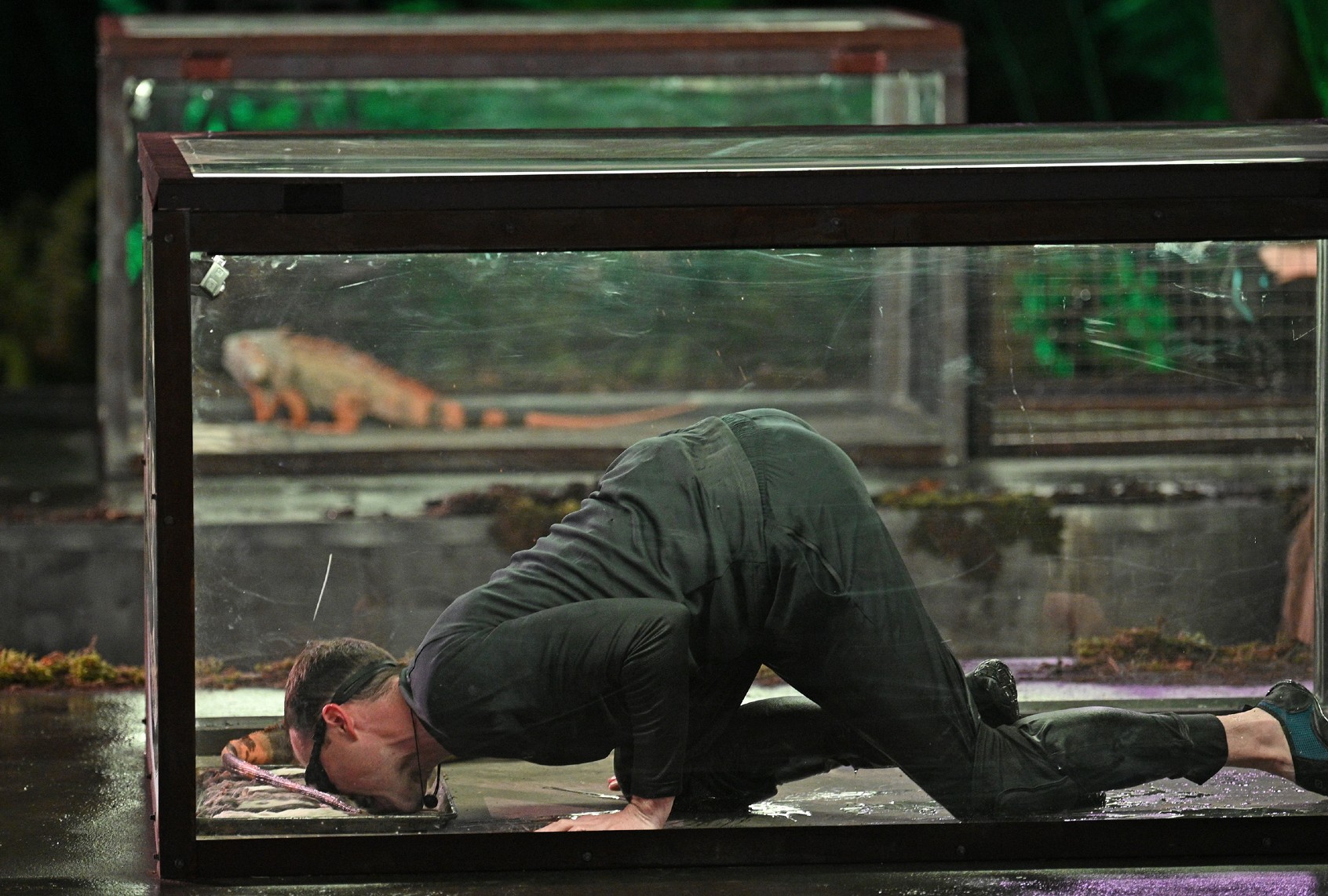
That’s the baggage that “Fear Factor: House of Fear” has dragged back, and it weighs the show down with diminishing returns. Nowhere is this clearer than in Episode 3’s elimination challenge, in which each of three contestants must crawl through a long, narrow terrarium tunnel filled with snakes and water, eventually making their way around an unimpressed iguana to a tray of dead rats that they must carry, one by one, back to the tunnel’s entrance using only their mouths. There is no fire in the eyes of the people bellying back and forth through the tunnel with rats swinging from their teeth; there is no sense that they are staring down their fears. If the challenge is making their humiliation as tedious as possible, well, done and dusted.
The grand prize, meanwhile, is also less than thrilling. In the original “Fear Factor,” the winner of each single-day episode could receive $50K if they completed its three challenges successfully. The “House of Fear” residents, by contrast, worked more or less around the clock during the month filming took place; aside from the actual gameplay, there’s in-house footage of strategy sessions, confessional interviews, and spats between players. The $250K prize is hardly chump change, but the joyless slog of the challenges thus far gives “House of Fear” the grim vibe of a “Squid Game” level-up.
In fact, the only person who seems to be enjoying the whole thing is Knoxville, for whom “Fear Factor” is a steep downgrade. The wisecracker who built an empire of anarchic whimsy, luring grown men away from professional careers in skateboarding and film to innovate ever more baroque ways to hit each other in the d*ck, did not have to stoop to reheating Joe Rogan’s leftovers; on the other hand, his cheerful overseeing is one of the few reasons “House of Fear” isn’t entirely bleak.
Expecting Americans to continue being entertained by the phenomenon that curdled our body politic is an awfully big ask for an industry that’s blithely destroying its own legacy. The programming that delivered us to, as Pozner says, “a reality-TV producer who had final cut on his fake master-businessman persona even though, off-camera, his businesses were bankrupt, and who now uses real people as pawns” in a fake reality whose existence he needs others to reflect back to him so he won’t disappear. Perhaps there’s a place down the road where the genre that restructured TV’s DNA will feel new and invigorated. For now, all we can do is rinse away the rancid aftertaste.
Read more
about reality television


