

Every time I’ve gone to the movies with friends recently, I’ve dreaded the inevitable. But the source of my dismay hasn’t been from the usual suspects, like seeing a phone light up in the middle of the film, or latecomers shuffling past an entire row of people after the movie’s started because they couldn’t bother to be on time like the rest of the audience. What I’ve anticipated is something much more sick and far more sinister, something that gives me a chill deep down to my bones: Ryan Gosling, looking at the camera at the end of the “Project Hail Mary” trailer, and saying, “So . . . I met an alien!”
The “Project Hail Mary” trailer has been tacked onto every single film I’ve seen for the last eight months. As if “Melania” weren’t already a dark enough experience as it was, there was Gosling, preceding the ice-cold first lady’s vanity documentary, delivering his line into the lens with a “so, that happened” smirk like this $200 million film was an episode of “The Office.” Despite my penchant for outer space films and my affinity for Gosling’s work, the millennial cringe of it all left a bitter taste in my mouth. We’re less than a year removed from the Pollyanna twee of “The Life of Chuck,” and daily life has only become more cruel. The last thing we need is another film trying to contend with our harsh reality with relentless, purblind positivity — seeing what felt like my hundredth glimpse of “Project Hail Mary” ahead of a doc about the neo-fascist administration felt like a slap in the face. Earlier this month, I walked into the movie theater again, armed with the sweet knowledge that I would finally be free from the trailer that haunted me for the better part of a year, if only because it was time to see the film itself. I was ready to have my suspicions confirmed. I was ready to roll my eyes. I did not expect to feel something magical wash over me: the feeling of surprise.
(Amazon MGM Studios) Ryan Gosling as Dr. Ryland Grace in “Project Hail Mary”
“Project Hail Mary” is primed to soften hearts once thought calcified, to make laughter echo throughout packed theaters full of moviegoers in desperate need of a lift, and to remind all of us just how astonishingly powerful big-budget, blockbuster filmmaking can be when done right.
Surprise — much less pleasant surprise — is a rare sensation these days. You don’t need me to tell you that it’s a rough world out there. I’ve lost count of how many times I’ve typed sentiments just like that in the first three months of this year alone. It often seems as though we are so far removed from happiness and goodness that these things will never be consistent again; they will only be here for a few fleeting moments, before being shrouded in brutal inhumanity once more.
So, you might imagine my shock when I found myself not just enjoying “Project Hail Mary” for its sunny disposition, but leaving the theater so genuinely moved that I believe it’s a film with the legitimate potential to bolster the human spirit. That this movie also happens to be the spring’s biggest blockbuster, based on a massively popular bestseller, is even better news. “Project Hail Mary” is primed to soften hearts once thought calcified, to make laughter echo throughout packed theaters full of moviegoers in desperate need of a lift, and to remind all of us just how astonishingly powerful big-budget, blockbuster filmmaking can be when done right.
If you’ve somehow avoided any knowledge of “Project Hail Mary” over the last year, you’re one of the exceptional few. Amazon MGM is putting all of their chips on this film, and for good reason: Andy Weir’s 2021 source novel was a hit among critics and especially among voracious readers of contemporary science fiction. The movie, co-directed by Phil Lord and Christopher Miller, with a screenplay by Drew Goddard — who earned an Oscar nomination adapting Weir’s “The Martian” for the big screen in 2015 — makes the complicated science and vast expanse of space accessible, even fun. Gone is the dour (though extraordinary) heft of “Interstellar,” and the historical context of “First Man,” which saw Gosling having significantly less fun playing Neil Armstrong. Here, as a middle school science teacher turned Earth’s last hope, Dr. Ryland Grace, Gosling gets the chance to match his affable charm to an equally enchanting story, with much more on its mind than turning the cosmos into a cosmic joke.
Gone (or, at least, largely reduced) is the awkward Reddit humor of Weir’s novel, replaced by the natural wit of Goddard’s skilled pen, which gracefully guides the viewer into a plot that feels both extreme and all too realistic. The sun is dying, and within 30 years, Earth’s temperature will cool to the point of global disaster, affecting crops, food sources, weather and humanity’s already precarious good nature. Ryland is approached by government agent Eva Stratt (Sandra Hüller), and reluctantly tapped to study what’s been dubbed “Astrophage,” the microorganism causing the sun’s dimming. Before long, Ryland is on a suicide mission aboard the Hail Mary spacecraft, where he’ll live out the rest of his days trying to find a way to combat the Astrophage’s effect and reverse the process of global annihilation.
Want more from culture than just the latest trend? The Swell highlights art made to last.Sign up here
That is, of course, not quite the whole story. The film’s narrative is scattered across two intersecting timelines that steadily build tension, suspicion and intrigue. A third of the story takes place on Earth in the months leading up to Ryland’s mission, while the rest is set aboard the Hail Mary, which Ryland must pilot toward Tau Ceti, one of the solar system’s few stars surviving the Astrophage’s catastrophic properties. It’s in Tau Ceti’s orbit where the Hail Mary intercepts communication from an alien spacecraft, which attaches itself to Ryland’s ship via a makeshift tunnel composed of organic matter, allowing Ryland to come face to face with the unknown.
As it turns out, the unknown isn’t quite so frightening. Ryland’s discovery couldn’t be further from the acid-tongued Xenomorphs of the “Alien” franchise. What he finds is a sweet, five-legged alien who appears to have a stone-like exterior. Naturally, Ryland nicknames his new acquaintance Rocky and quickly realizes they’re both the only survivors aboard their ships, tasked with the same mission: save their dying planets.

(Amazon MGM Studios) Ryan Gosling in “Project Hail Mary”
What’s particularly remarkable about “Project Hail Mary” is that the film has just about everything stacked against it. Without sense, it could be a myopic rumination on climate change mixed with a treacly buddy comedy, where two opposing temperaments clash into a discordant, aggravating mess. Without vision, it could be a regurgitation of just about every space film we’ve seen this century. Without compassion, it could be just another page-to-screen adaptation — a cold yet surefire money-maker, devoid of the mortal benevolence a film like this demands to truly connect with an audience more than ready to give up hope, if they haven’t already.
There’s a longing buried deep within Hüller’s voice, a vulnerability that stretches beyond the confines of the film and into the audience — not to shake sense into them, but to lay a hand on their shoulders. It is, quite simply, one of my favorite sequences I’ve seen in any film in a very, very long time.
Miraculously, “Project Hail Mary” has sense, vision and more than enough compassion to spare. Lord and Miller’s film brims with ingenuity, composed of wondrous practical effects and some brilliant puppetry work to make Rocky as lifelike and adorable as he is, combined with intentionally scant VFX and animation to ensure realism at every possible turn. On the silver screen, it dazzles like few contemporary science fiction films do, opting for color over the pallid gray verisimilitude that often bogs down its peers. That “Project Hail Mary” venerates the art of filmmaking is just one of its many marvelous aspects, but one that should not be overlooked. This is a film that has the viewer in mind every step of the way, and that consciousness will pay dividends well into the future.
All this sincerity trickles down to the performances, too. Gosling is typically terrific, but “Project Hail Mary” is practically tailor-made for his brand of disarming allure. Even when Ryland looks into the video camera he records himself with to send dispatches back to Earth, it feels less like a character on a dated single-cam sitcom, and more like Gosling is relishing the chance to refine the details of Grace’s personality and specific neuroses. He’s both movie-star hunky and action-star engrossing, flitting between these two deceptively binary ends without breaking a sweat. As Ryland works to translate Rocky’s language and build a system for the two to communicate, the bond formed between human and pentapedal boulder is palpable. The engaging and often heartwrenching connection between the two is the film’s emotional centerpiece. Even the sequences of obvious pathos are earned, over and over again.
There is one moment, though, that must be given special attention; a scene that sent chills all over my body and made me question just how much my own heart has hardened to our modern era’s constant strife. In one scene still set on Earth, in the final days before the Hail Mary travels to space, the ship’s crew and others who have been working tirelessly to prepare for the mission blow off steam, drinking and singing karaoke together. After Eva and Ryland briefly ruminate on fear and primal instinct, Ryland’s otherwise direct and unemotional government superior takes to the mic, performing a cover of Harry Styles’ “Sign of the Times.”
What should be the most cringeworthy sequence to echo through multiplexes this decade is, magically, one of its most immediately touching. Hüller’s voice begins small before unfurling into a mighty, sonorant exclamation until it’s brought back down again, like a woman who’s reluctant to let herself have too much faith in the impossible. Her performance is tinged with the unmistakable sound of uncertainty. There’s a longing buried deep within it, a vulnerability that stretches beyond the confines of the film and into the audience — not to shake sense into them, but to lay a hand on their shoulders. It’s a small scene within the film’s enormous scope, but a critical addition that singlehandedly makes the film all the more special. It is, quite simply, one of my favorite things I’ve seen in any film in a very, very long time.
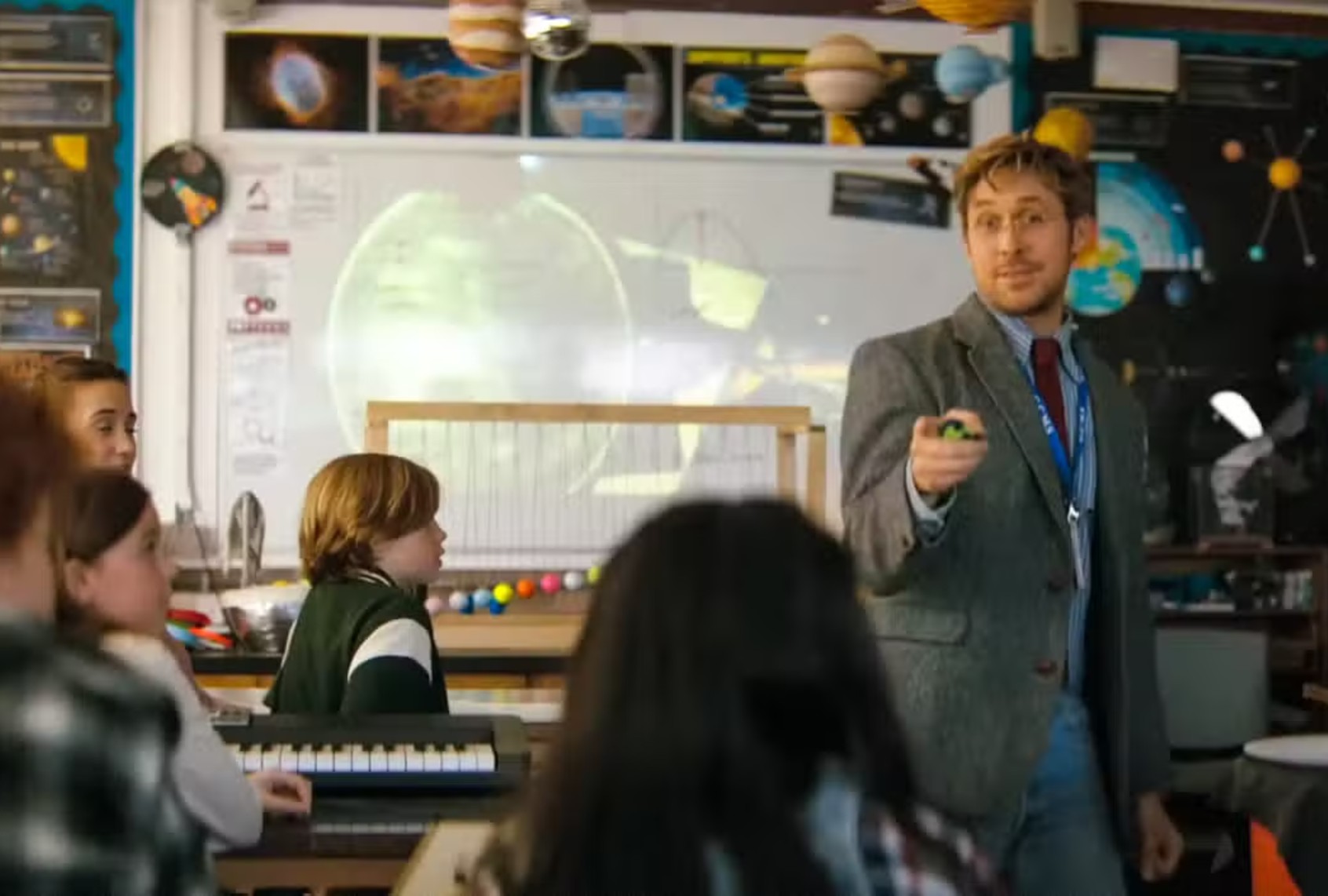
(Amazon MGM Studios) Ryan Gosling in “Project Hail Mary”
Sure, I can relent that “Project Hail Mary” is less urgent than this year’s best picture winner, “One Battle After Another,” and not as hyper-specifically relevant to our times as “Eddington.” But it’s refreshing to see a film operate outside of the gray area, where so many movies of its ilk have gotten lost in recent years. There’s little time spent on subtext, and even less on preaching. The film doesn’t waste time trying to convince us that we’re all united by our existence; it outright shows us, using its luminous visual landscape and character writing to captivate before anyone has a chance to let smug sanctimoniousness win.
“Project Hail Mary” harkens back to a simpler yet still very recent time, when movies of its scale were allowed to dazzle and yank at the heartstrings by appealing to the core of our humanity, instead of commenting on the violence our species has wrought. The film gets to the heart of the matter quickly and stays there, spreading out to make itself comfortable. It confronts dire truths with a kind heart. Despite all the times I shuddered at the trailer tagline, “Believe in the Hail Mary,” over the last year, I really do. I believe in it, and in this film’s ability to make a lot of very jaded people care even that much more. And as corny as that may seem, I implore you: If you have even one microscopic iota of curiosity, see this film. I think you’ll be glad you did.
Read more
about films that will change your perspective


