

It’s rare for a children’s movie to leave the viewer with more questions than answers. Brevity is their whole point. In a relatively small window of time, kids get a two-for-one special: entertainment and wisdom. Given their limited attention span, the last thing a child needs is a film chock-full of loose ends to distract from the crux of the story. And while some writers, directors, animators and studio executives might think that a kid won’t notice incompetence, they couldn’t be more wrong. Children can be just as unforgiving as adults when it comes to movies, which is probably why, until this week, I couldn’t ever bring myself to rewatch “Cars.”
Growing up, I was a Pixar evangelist, obsessed with the studio’s excellent output. Their films dazzled me to no end and pushed my imagination past its furthest boundaries. But beyond the animation itself, the writing was always truthful. Pixar films are known for their gut-wrenching sincerity, speaking to kids with as much candor as they do adults. That earnestness was always my favorite element of their work. The beautiful, sometimes brutal honesty brought me back to “Monsters Inc.” and “Finding Nemo” more times than I could count. Without fail, the miniature version of me would blubber at Sully the polka dot monster reuniting with Boo, and Marlin the clownfish traversing the ocean to find his son. I had to pause momentarily while writing this paragraph just to wipe a tear from the corner of my eye.
(Jeff Gritchen/MediaNews Group/Orange County Register via Getty Images) Cruz Ramirez, from the Disney/Pixar movie “Cars 3”
By the time “Cars” rolled around, I was of the mind that Pixar could do no wrong. But that was before I understood that what goes up must come down. And with their seventh studio film, Pixar plummeted to the ground with such a force that I began to question my undying devotion to an animation studio. Could my beloved Pixar, which had already anthropomorphized so many things, really make something so upsetting and perplexing, and on so many levels? I can still remember the sunlight’s glare as I walked out of a summer matinee 20 years ago, the harsh daylight illuminating all of the questions lingering in my mind about this alternate reality where everything looks the same; where humans never existed, yet cars somehow did.
So long as “Cars” could make Disney billions of dollars, the film itself being a veritable clunker was a non-issue. By allowing its primary cinematic output to be devalued, Pixar sold off its imagination and lowered its artistic standards — a mistake the studio is still struggling to come back from.
How do the cars eat? How have they built entire cities and extensive infrastructure with no thumbs? If there are child cars, how do the adult cars have sex? What is birth like? Do the children grow into adults, or are their smaller car parts replaced with larger car parts — and if so, how do they retain their consciousness during this process? If there are racecars, sports cars, and beat-up jalopies alike, are the cars born into their occupation? Do they live in a caste system? What came first, the sprocket or the oil? I’ll spare you, but I could keep going for hours. These questions haven’t left my mind for two decades.
“Cars” invites a type of rumination no child should ever have to endure, especially during summer break. But these lingering queries are hardly the film’s worst feature. Aside from being terribly boring and overlong, “Cars” represents Pixar’s first blatant step toward becoming a capitalist behemoth, an animation studio that would continue to prioritize money over media to this day. In fact, the film’s dullness only underscores the significance of this transition. It didn’t matter that “Cars” was the studio’s worst-received film to date, or that its worldbuilding was so nonsensical it would become a sticking point for viewers over the next 20 years. What was important was merchandising: toys, theme parks, soundtracks and franchises. So long as “Cars” could make Disney billions of dollars, the film itself being a veritable clunker was a non-issue. By allowing its primary cinematic output to be devalued, Pixar sold off its imagination and lowered its artistic standards — a mistake the studio is still struggling to come back from. Though those effects weren’t immediately visible.
For animation at Pixar’s level, a single two-hour film requires years of production work. This was especially the case during the 2000s, when software and processes were not as sophisticated or streamlined as they are today. The three films that succeeded “Cars” — “Ratatouille,” “WALL-E” and “Up” — were all in some stage of pre-production before “Cars” hit theaters in 2006. That trio of films saw Pixar to the end of its golden era, indicating to audiences that the studio still had plenty of novel, workable ideas and no shortage of valuable life lessons to impart to its young viewers. Beyond that, they were also beloved by critics and audiences alike, with “WALL-E” deservedly earning a spot in the Criterion Collection in 2022, designating the film as a significant work within the medium of cinema. I don’t know a single person who would say the same thing about “Cars 2” without a gun pointed at their head, but I’m getting ahead of myself.
For Pixar fans, the writing was on the wall as soon as “Cars” premiered. The film didn’t share the same ambition or expansive scope as its predecessors. And while there’s nothing wrong with that per se, being so confined to a single location is one of the movie’s most glaring missteps. Directed by John Lasseter, the film is a love letter to classic Americana, as seen through the unsettling bug eyes of a cast of automobiles, led by the arrogant rookie racecar, Lightning McQueen (Owen Wilson). After a spate of big wins, Lightning is about to face his biggest race yet, competing for the Piston Cup. But on his way to the race, a minor road accident leaves Lightning stranded in Radiator Springs, a tiny town off Route 66 that’s seen better days. There, Lightning gets to know the town’s colorful cars and discovers that glory isn’t all it’s cracked up to be if you have no one to enjoy it with.
Want more from culture than just the latest trend? The Swell highlights art made to last.Sign up here
That may be a nice lesson to learn, but it’s a real snooze to watch. If you’re not a fan of cars, there’s little to admire about the character design. And although the animation is typically stellar, there are few opportunities to truly appreciate all of the work that went into creating this world.
Whereas “Finding Nemo” gave viewers an intimate view of the ocean’s vast beauty, and “A Bug’s Life” provided a close-up view of the imperceptible universe microscopic organisms spend their lives in, “Cars” is content with simply mirroring what the eye can already see. These are the kinds of places humans can already go, if they so wish. “Toy Story,” at the very least, saw this same everyday world through a new lens, asking children to wonder what it would be like if their toys had entirely separate lives outside of playtime. The only thing about “Cars” that fuels a child’s fantasy is replacing humans with automobiles in an environment that looks exactly like ours. And even then, I’d argue that conflict is more puzzling than inspiring. (Again, I must wonder: If the real Jay Leno, known for his collection of classic cars, plays a character named Jay Limo in the film, does Jay Limo also . . . collect cars? And if so, are these being imprisoned? There are morally and ethically dubious questions aplenty.)
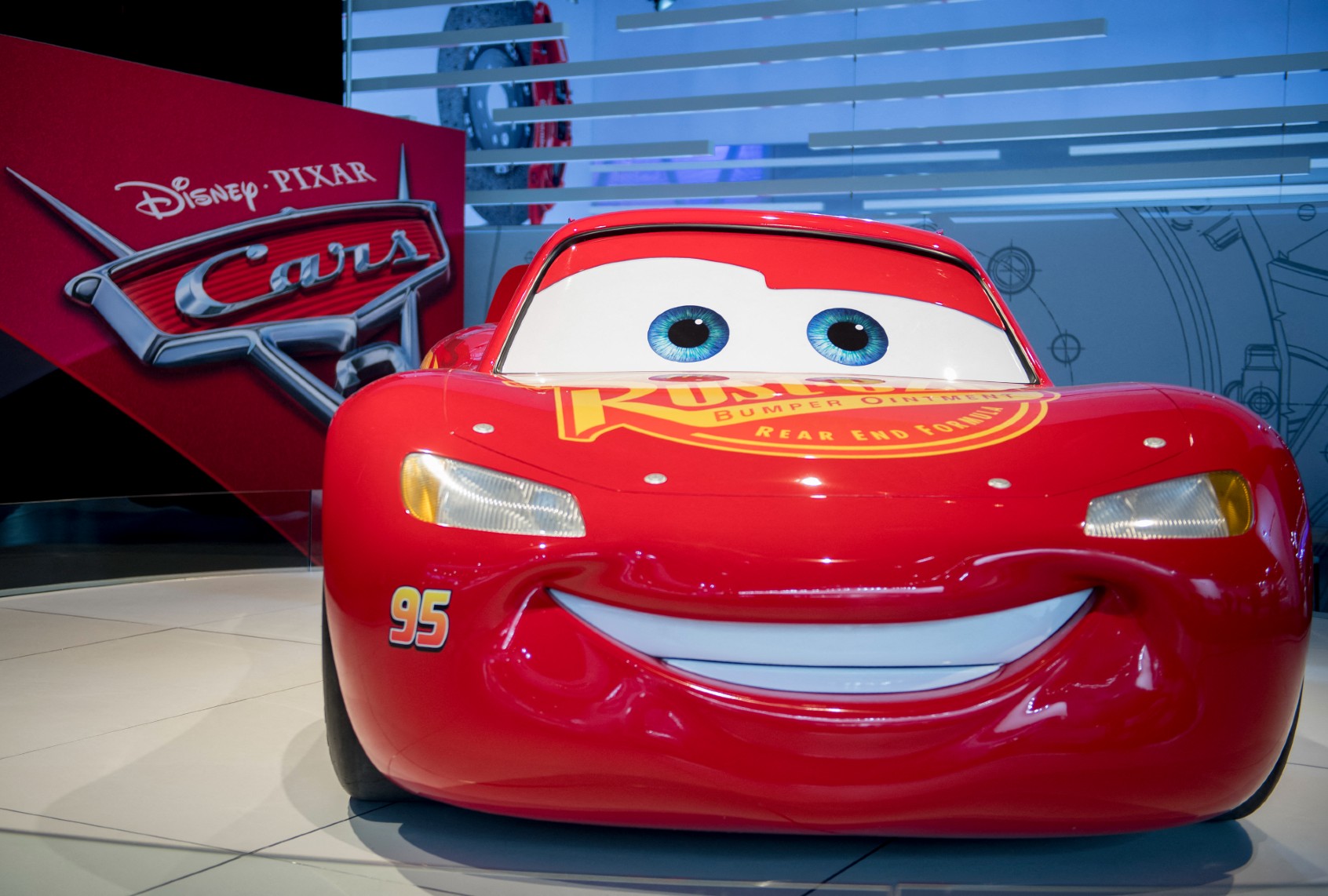
(JIM WATSON/AFP via Getty Images) A model of Lightning McQueen from the Disney Pixar movie “Cars 3”
None of these middling elements would be particularly grating if it weren’t so apparent that “Cars” had an ulterior capitalist motive. I don’t agree with applying gender to toys, but it seems more than convenient that the Western world’s most successful animation studio happened to create characters that could be easily transformed into the same type of toy that’s been marketed to young boys for decades. “Cars” merchandise fit nicely alongside Hot Wheels and model trains, something you could put in a child’s hand and have them zooming along walls for hours on end. Other Pixar films got the toy treatment, too — this is Disney we’re talking about — but I can’t be convinced that the House of Mouse wasn’t delighted that the figurines for the characters in that summer’s Pixar tentpole already had a massive, built-in customer base.
The numbers don’t lie, either. By 2011, “Cars” had moved $10 billion worth of merchandise alone, which Lasseter attributed to the strength of the story. “When you see a child out there in the world having a toy of our character, it means they really, really love that character.”
I must wonder: If the real Jay Leno, known for his collection of classic cars, plays a character named Jay Limo in the film, does Jay Limo also . . . collect cars? And if so, are these being imprisoned? There are morally and ethically dubious questions aplenty.
And while that may be true in some cases, there’s no accounting for how much money was spent by adults — relatives taking a chance on a random Christmas gift for their nieces and nephews, parents trying to placate a kid crying in the toy aisle with an impulse buy. The number of licensed toys I had as a kid for characters I really didn’t give a damn about is embarrassingly exorbitant. I don’t buy that any kid watching “Cars” wants a Lightning McQueen racecar because of Owen Wilson’s dry dialogue and tepid jokes. It’s because he’s a car! It’s because he goes fast! It’s because he can jump off stuff while kids make a “vroom” noise! The appeal has nothing to do with the quality of the film itself and everything to do with cars being a recognizable part of everyday life.
Looking to keep up that enormous success, “Cars 2” and “Cars 3” followed in 2011 and 2017, respectively. The former is a truly abysmal “spy film,” if you can degrade the genre by calling it that, while the latter is the best in the franchise, which isn’t saying much. Neither movie does anything particularly interesting with its characters, but what’s most frustrating is that the humility Lightning McQueen learns in the first film is essentially tossed out the window. If these sequels prove anything, it’s that “Cars” was never about the insights it could provide the audience, but rather, the money it could extract from their wallets.
Moreover, the follow-ups indicated to Disney that other Pixar franchises could be a viable revenue stream, no matter the public’s response to the films. “Cars 2” was received more poorly than any Pixar film at the time, and yet, a third film in the series was ordered anyway — followed by “Cars Toons,” the animated short series that ran from 2008-2014 and the Disney+ miniseries, “Cars on the Road,” in 2002.
And while “Toy Story” was Pixar’s first film to get a sequel, there’s an immense difference in overall quality between the two franchises. The main “Toy Story” franchise has yet to take a major stumble because the franchise has great bones. Its roots are in imagination, which means there are plenty of additional narratives to conceptualize. The same can’t be said with cars. Once you’ve watched one drive, you’ve seen them all drive, though I’m sure Elon Musk and all of the Tesla Uber drivers who have watched me struggle to open that ridiculous door would disagree.
The “Cars” franchise may have, God-willing, come to an end, but Pixar is still suffering the consequences. There’s no doubt, “Cars” lowered the bar for the studio. Suddenly, a film that was just fine could be deemed a runaway, billion-dollar success. Adequacy became the studio’s M.O. Instead of knocking the ball out of the park every time they stepped up to the plate, Pixar started to strike out frequently, deferring to more sequels and spinoffs to bring in nostalgia dollars, and half-baked original films like “Onward” and “The Good Dinosaur” that recycle elements of the studio’s most beloved films and regurgitate them in dingy packaging.
Though all hasn’t been entirely lost. “Soul” was quite beautiful, tinged with the innovative, educational spirit of early Pixar, and “Hoppers” did a wonderful job combining fantastical story elements with a grounded, human edge. Maybe with “Cars” safely in the rearview mirror, and me having just exhausted my one bad pun per story with this sentence, Pixar can return to consistent greatness. But with two more franchise sequels on the horizon, and thousands of persistent questions about those dastardly anthropomorphic cars floating around my head until the day I die, I’m not quite ready to move on — at least not until I find out why the cars have passenger doors if there are no humans.
Read more
about what’s up at Pixar


