

There comes a time in every English-speaker’s life when they learn the meaning of the French phrase “la petite mort,” an adage that, translated literally, means “the little death,” and typically refers to the sensation immediately following an orgasm. Given the phrase’s innate poeticism, it’s often used by scholars, authors, casanovas and perhaps overly didactic filmmakers to convey the fleeting intensity of life’s most burning joys. But most obnoxiously, “la petite mort” is a favorite of black-coffee-sipping, cigarette-bumming, beret-wearing young adults, eager to remind you that the phrase can also allude to a part of oneself, deep inside, that has died — snuffed out by the pain of existence. “Don’t you see?” they ask between puffs of their Parliaments. “Everything has a dual meaning.”
That’s precisely why, upon first hearing that the metafictional antagonist in writer-director Jane Schoenbrun’s latest film, “Teenage Sex and Death at Camp Miasma,” is called Little Death, my body responded with a sharp, involuntary wince. Uh oh. See, it’s not that “la petite mort” isn’t a beautiful, lyrical phrase on its own; it’s just that its novelty wears off quickly. It’s not exactly the kind of metaphor you want to hang an entire film on, lest its relative simplicity give way under the heft of a feature film’s many parts. Then again, unflinching and sometimes self-important intellectualism is a major aspect of Schoenbrun’s whole oeuvre.
(MUBI) Jack Haven as Little Death in “Teenage Sex and Death at Camp Miasma”
At every turn, Schoenbrun buries the movie alive, heaping layer upon layer of meta subtext onto it. And while excavating those layers isn’t exactly a demanding task as a viewer — what with them being so thin and all — at a certain point, one gets tired of digging, knowing that the once-promising film at the bottom has already been reduced to its bones.
In the last few years alone, Schoenbrun has proven themselves one of cinema’s most promising new voices, carving out a substantial space for a mainstream trans filmmaker in an industry still dominated by cisgender, heterosexual white dudes with weird haircuts. Their films are strange and gorgeously imagined, like hazy clouds of half-remembered dreams that nip at the back of your mind all afternoon as you try to interpret their meaning — until Schoenbrun shines a spotlight on it for you. The resulting rug-pull is a sensation akin to trying to remember an actor’s name. You reassure your friends that you don’t need their help; you’ll get it with just a second to think. “Don’t tell me, don’t tell me!” you beg. And then, they tell you anyway with a proud look on their face, eliminating the chance to experience the satisfaction that comes with figuring something out on your own.
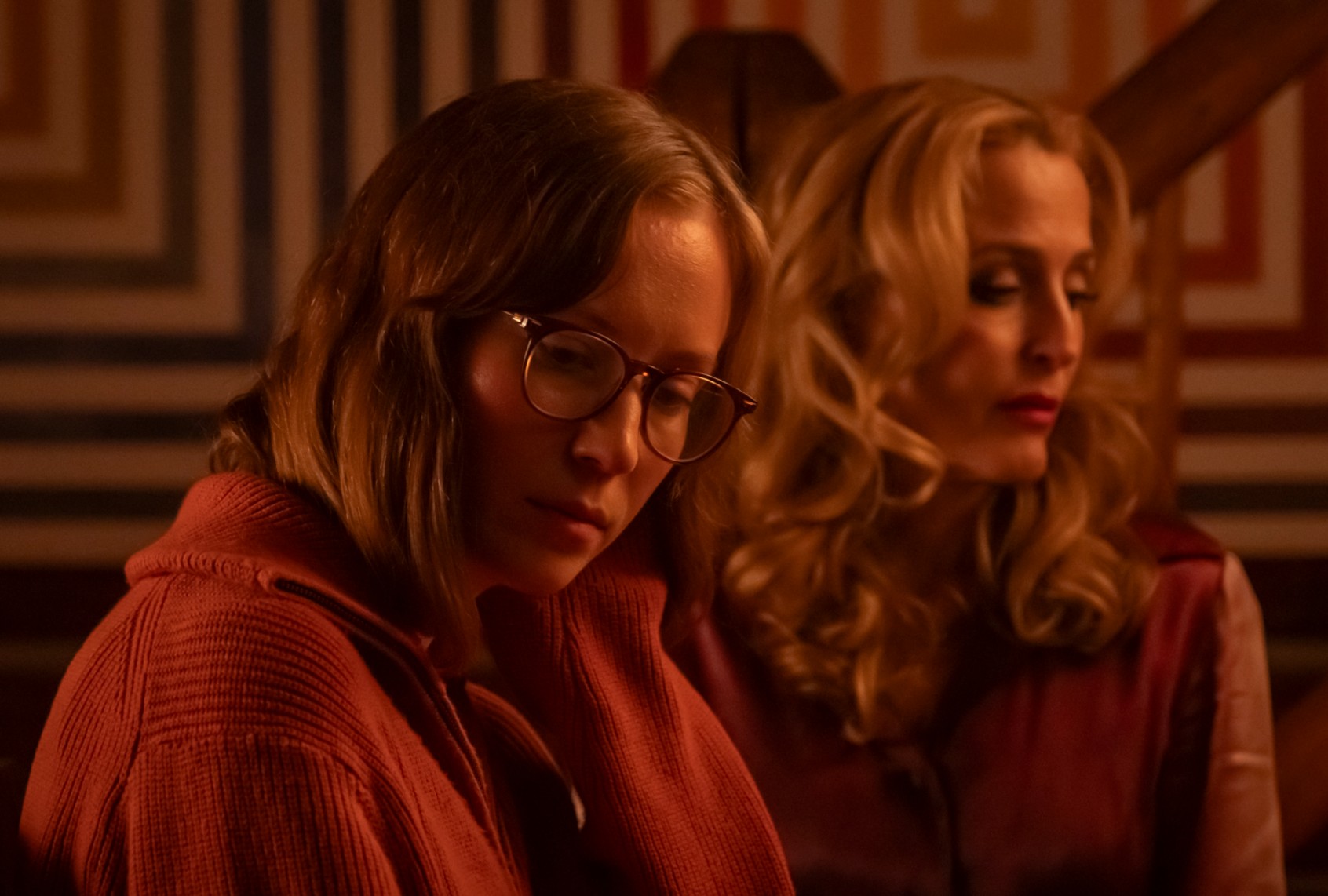
(MUBI) Hannah Einbinder and Gillian Anderson in “Teenage Sex and Death at Camp Miasma”
“Teenage Sex and Death at Camp Miasma” is, regrettably, no different. The movie finds young queer filmmaker Kris (Hannah Einbinder) tasked with rebooting the retro-slasher franchise, “Camp Miasma” — a cross between “Friday the 13th” and “Sleepaway Camp” — with a more “woke” voice. Kris tracks down the reclusive final girl from the series’ first film, Billy Presley (Gillian Anderson), hoping to convince Billy to star in the reboot. Media-obsessed and identity-focused, Kris’ neuroses immediately counter Billy’s cool, Southern demeanor as the two women huddle up at Billy’s house in the wintry woods, where they soon discover a powerful physical connection forged by the “Camp Miasma” films.
Want more from culture than just the latest trend? The Swell highlights art made to last.Sign up here
Kris initially refutes their chemistry, pushing it away in favor of her work. But Billy persists, patiently trying to help Kris past the fog of her sexual repression (“la petite mort”) and toward sexual satisfaction (“la petite mort”). One little death precludes the next, until the in-universe Little Death comes calling, armed with 10 to 17 more half-sketched metaphors hanging from the sharp tip of his bloody harpoon.
Schoenbrun’s messaging is about as subtle as a punch to the face or a spear to the heart. There is, of course, a place for that, too, especially in a film that is a partial send-up of tactless slasher movie tropes. Yet Schoenbrun’s observations are presented in the film as though they’re opaque, overloaded with smug surrealism and jam-packed with visual stimuli designed to wink and nudge at the otherwise obvious. At every turn, Schoenbrun buries “Teenage Sex and Death at Camp Miasma” alive, heaping layer upon layer of meta subtext onto it, killing it slowly. And while excavating those layers isn’t exactly a demanding task as a viewer — what with them being so thin and all — there are so many to parse that, at a certain point, one gets tired of digging, knowing that the once-promising film at the bottom has already been reduced to its bones.
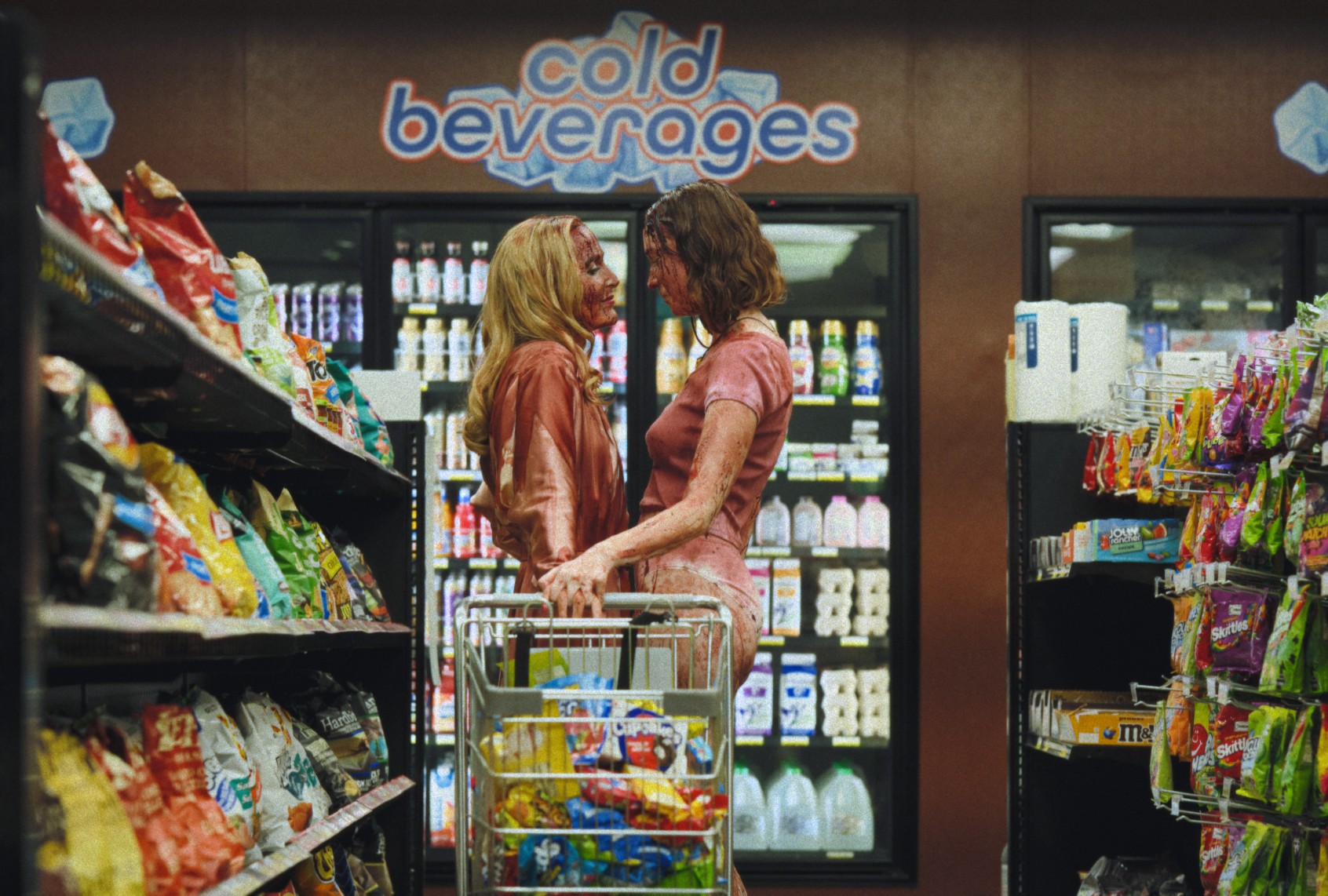
(MUBI) Gillian Anderson and Hannah Einbinder in “Teenage Sex and Death at Camp Miasma”
Granted, all of this is part of the point, and that’s a major reason why “Teenage Sex and Death at Camp Miasma” is so exasperating. Early in the film, Billy tells Kris that she’s approaching her reboot of the in-film “Miasma” franchise “too academically.” The audience instantly understands that this is Schoenbrun riffing on their own intellectually minded approach, and that Kris is a self-insert character for the movie’s writer-director. Kris explains that she knows the studio hired her solely because she’s queer, as only a queer person could revamp an outdated, transphobic slasher franchise without Big Cancel Culture piping in. But what the Hollywood suits don’t realize is that Kris has been a “Camp Miasma” obsessive since childhood. She’s extremely interested in the ways problematic movies can be reclaimed by the real-life minority figures depicted in them, and what can be gleaned from studying these films’ merits.
Kris calls the original “Camp Miasma” film her sexual awakening, but can’t exactly put her finger on why. All she knows is that she’s fascinated by a look Billy’s character has in her eye during a sex scene, and that she hasn’t been able to get it out of her mind for her whole life. She wants to explore her pleasure, but there’s a mental block keeping her from doing so.
Here, Schoenbrun touches on a very real and very interesting shared experience within the trans community, remarking on the dissonance between embracing one part of yourself, but being at odds with another — in Kris’ case, her queer identity versus her practiced sexuality. (This is made somewhat tenuous by casting a cis actor like Einbinder, but I digress.) When you work so hard to come to terms with who you are, and when there is so much sexual violence directed toward you in both real life and media, letting yourself be seen as a sexual creature can be a very frightening experience.
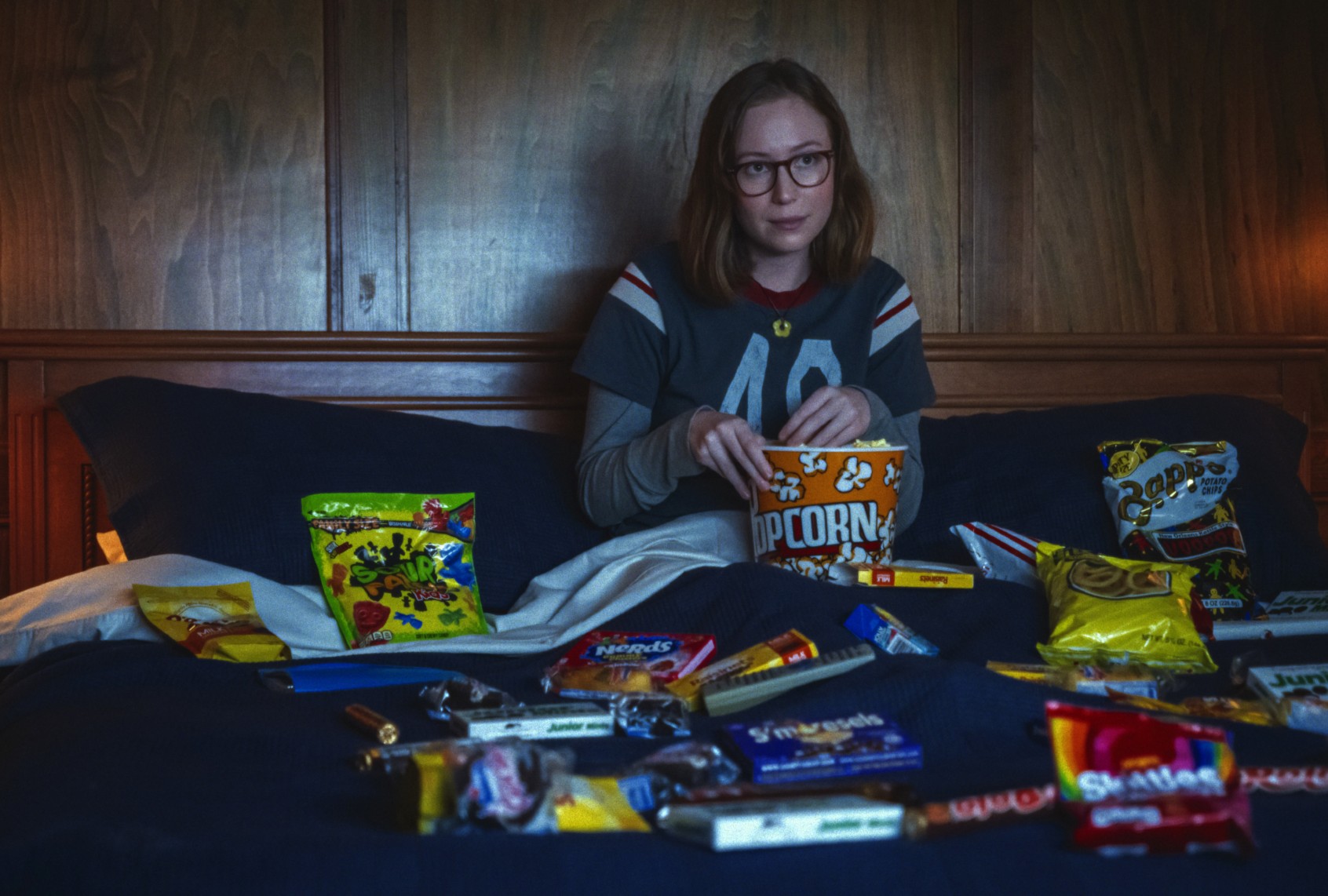
(MUBI) Hannah Einbinder in “Teenage Sex and Death at Camp Miasma”
With Billy’s help, Kris comes to understand that it’s the final girl fantasy that turns her on. She wants to run through the woods, vulnerable and boobs a’bouncing. She craves the helplessness, Little Death’s (sigh) phallic instrument pressed against her skin. She wants to give herself over to it, to turn her brain off and release herself into someone’s control. But understanding the fantasy and accepting it are two different things, separated by a sea of unwarranted shame.
As was the case with Schoenbrun’s previous two films, once a grand idea starts to take shape in unique and compelling ways, reality and fantasy must blur, forcing a new layer of subtext about “the media” as an alluring and edifying, yet potentially harmful, entity to emerge. Schoenbrun depicts extended sequences from the in-universe “Camp Miasma” movie, notably directed by Ray Blanchard, the real-life sexologist whose theories of autogynephilic sexuality claim that identification with a desired sex can make a person wish to be the desired sex.
If horror is “flesh and fluids,” then the flesh of this movie is a body comprised of nebulous ideas. When sliced, loose metaphors and half-sketched allegories gush forth, fluids staining the viewer’s clothes blood-red. The film’s body is drained — an inanimate husk. Its lifeblood of ideas is now the audience’s responsibility.
In short: The winking Blanchard reference supports Kris’ shame about the “Miasma” movies causing her to see herself in an autogynephilic way — the heterosexual man’s fantasy of a woman in peril. But worry not, even a viewer who doesn’t know who Blanchard is can surmise this correlation to the bigger picture thanks to Schoenbrun quite literally spelling it out for us. While rewatching one of the “Miasma” sequels, Kris takes out a pen and paper, writes the word “DESIRE” in all caps, and underlines it twice.
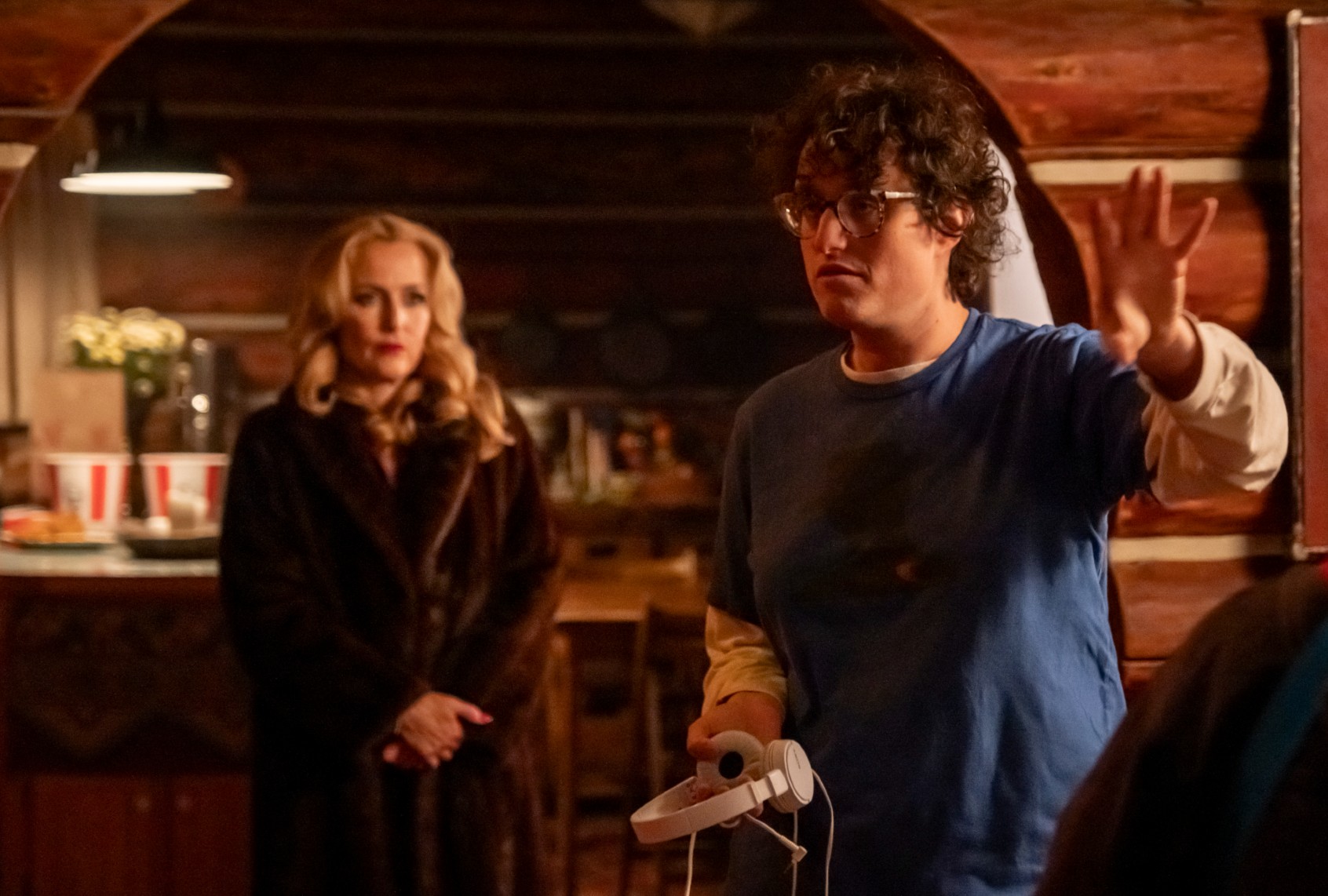
(MUBI) Gillian Anderson and Jane Schoenbrun on the set of “Teenage Sex and Death at Camp Miasma”
It’s clear that, with “Teenage Sex and Death at Camp Miasma,” Schoenbrun seeks to marry their affection for absurd, often quite obvious ways that horror movies execute their themes with their own penchant for the intellectual and analytical. All that is great, and would conceivably make for a very great film — if there were any film at the core of all of these ideas. But the characterizations are too flimsy, the world only moderately textured. Narrative elements that could round out the film into something truly meaty are left on the floor in favor of more metaphors, like a pizza shop running out of sauce and throwing more cheese onto the pie, hoping a customer won’t notice an integral piece is missing. Even the handful of beautiful, hand-painted practical backgrounds seem to be laden with implied allegory. Their semi-fantastical style almost recalls the works of Thomas Kinkade. Kinkade. Kink-aid. Billy’s helping hand, aiding Kris’ kinks. Little Death. Desire. It’s all, frankly, a lot and not enough at all.
Early in the film, Billy refutes Kris’ overcomplicated idea of horror films. “Horror is just flesh and fluids,” Billy tells her. And if one were to assume everything here has deeper meaning, as I’d wager Schoenbrun is begging their audience to do, this is a perfect way to illustrate how “Teenage Sex and Death at Camp Miasma” stumbles. The flesh of this movie is its body, comprised of nebulous ideas. When that body is poked, prodded and sliced, loose metaphors and half-sketched allegories gush forth, fluids staining the viewer’s clothes blood-red. The film’s body is drained — an inanimate husk. Its lifeblood of ideas is now the audience’s responsibility.
While some of these ideas may be profoundly relatable — and thus, personally meaningful — that doesn’t make the observations or their executions within Schoenbrun’s feeble film profound in and of themselves. Unlike most of Schoenbrun’s diehard fans seem to think, a difference of opinion about art doesn’t negate either person’s feelings. But like its creator, Schoenbrun’s film asserts that media can be integral to personal identity. “Teenage Sex and Death at Camp Miasma” encourages fans of the film to fire back at its detractors with “you didn’t get it,” even though the film is incredibly easy to understand. They want to protect Schoenbrun’s film from the very analysis it’s encouraging, the deep, granular kind that causes all that subtext to fall apart. The problem with boarding the train to true profundity and disembarking at “la petite mort” is that, if you linger there long enough, you start to forget that there’s much more to life and movies than sex and death.
Read more
about films that don’t give it all away


